OpenAPI-to-MCP gateways are having a moment because they solve a real integration bottleneck: teams can take an existing API surface and expose it quickly as tools an agent can call. That is a major unlock for delivery speed.
But there is a crucial distinction to keep in view: API connectivity is not API authorization. Turning endpoints into tools gives an LLM reach. It does not, by itself, define what that reach should be, under which user's authority, for which business intent, with what approvals, and with what audit trail.
How OpenAPI-to-MCP gateways work in practice
At a high level, an OpenAPI document is parsed into callable tool definitions, then hosted behind an MCP server endpoint so agent runtimes can discover and invoke them. A path like GET /customers/{id} becomes a read tool, while POST /invoices becomes a write tool, complete with input schema derived from the OpenAPI spec.
You can already see this pattern in products like corelayer0, which emphasizes a flow from OpenAPI upload to hosted MCP URL, with endpoint filtering, OAuth 2.1 connectivity, and server-side credential injection. The public discussion around this direction is also visible in community threads such as this DaedalusAgents post. The implementation details vary, but the architectural move is consistent: schema-to-tool generation plus hosted MCP access.
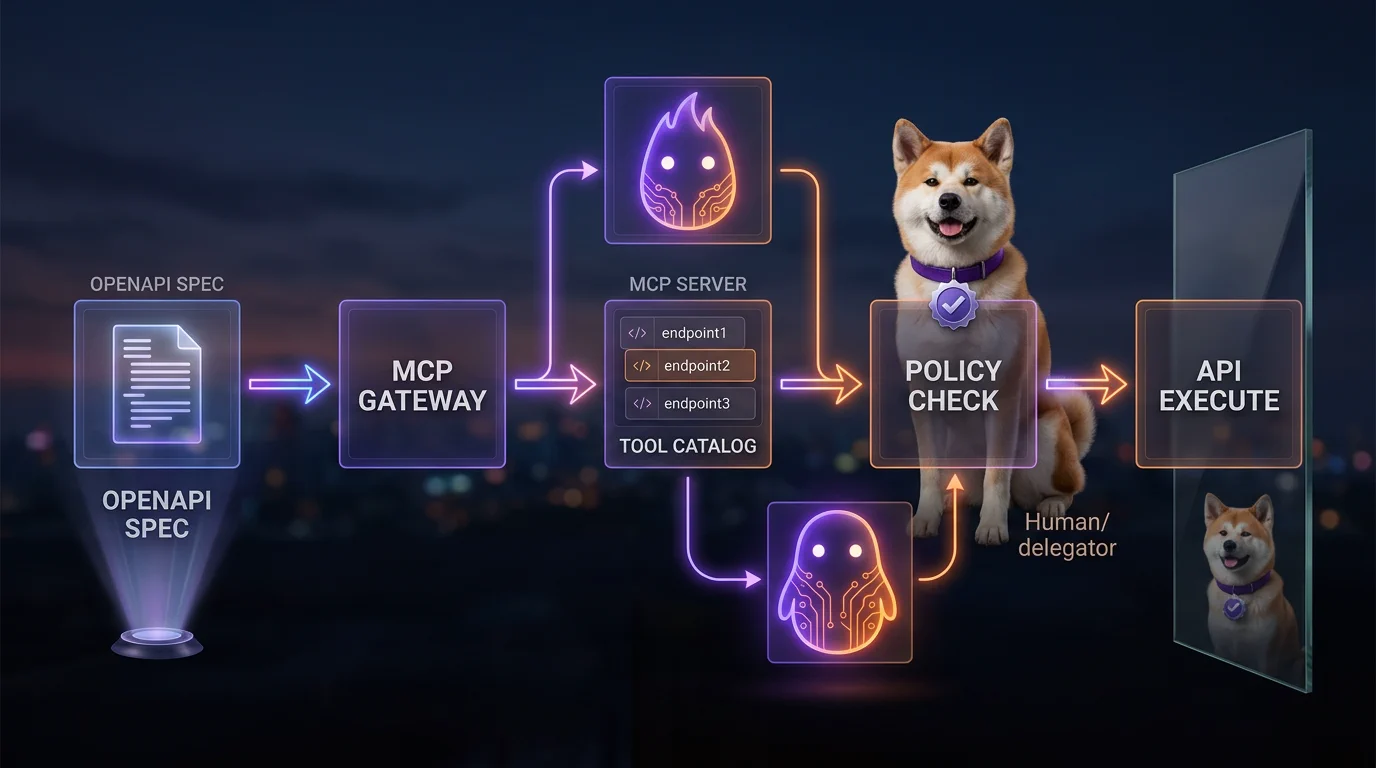
Once you auto-generate tools from an entire OpenAPI file, the tool catalog can grow from a handful of safe operations to hundreds of mixed-risk actions. The agent no longer sees "an API"; it sees a menu of executable capabilities.
That shift is why teams get surprised. A tool named deleteCustomer, exportTransactions, or transferFunds may be only one call away from benign tools like listCustomers. If the runtime contract is only "tool exists, tool callable," the model's planning behavior can chain high-impact actions with no semantic guardrails beyond basic auth.
So the central design question is not "Can the agent call this endpoint?" but "Under what delegated authority, for what intent, and at what risk level should this tool be callable now?"
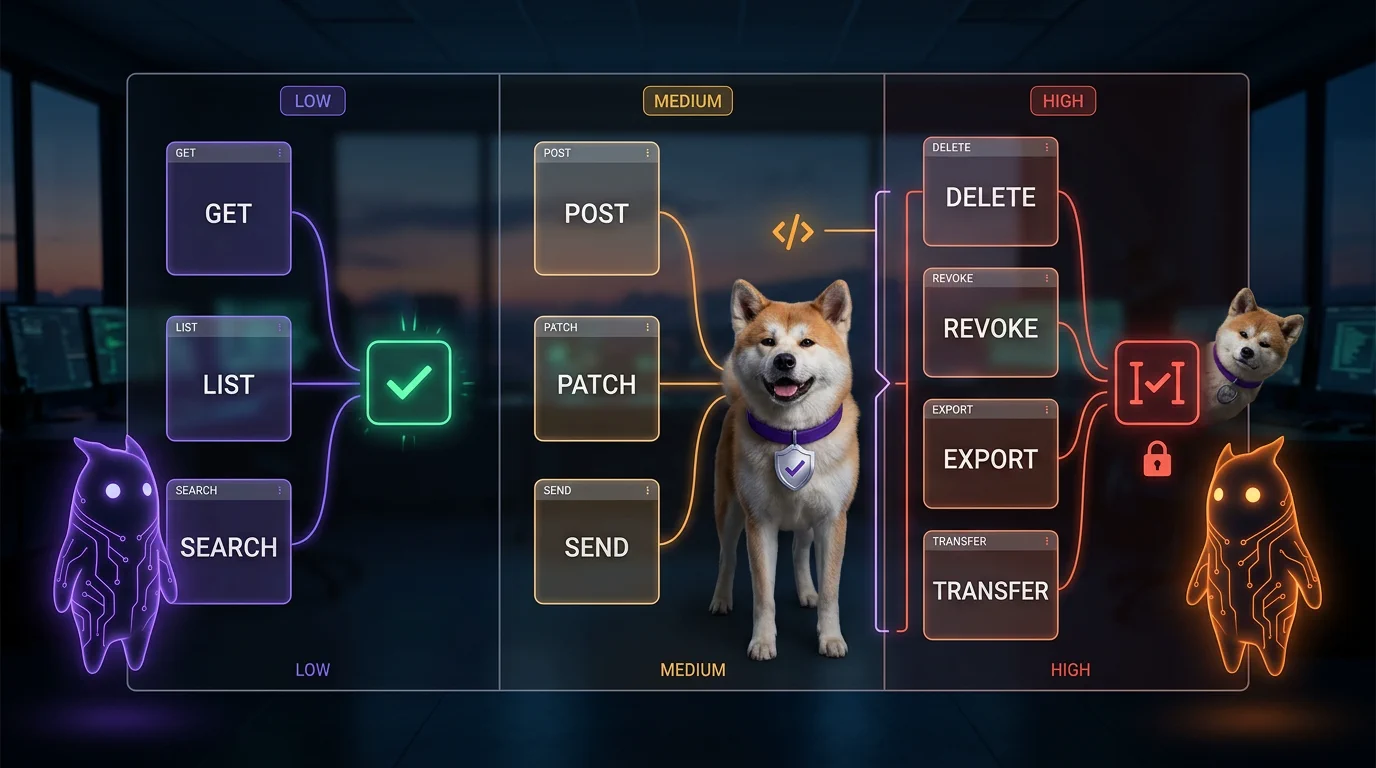
The fastest practical control is risk classification at tool generation time, then enforcement at runtime. Start by mapping endpoint semantics to trust bands:
- Low trust risk:
GET, list, search, read-only retrieval.
- Medium trust risk:
POST, PATCH, send, state-changing but recoverable actions.
- High trust risk:
DELETE, revoke, export, transfer, destructive or exfiltration-sensitive actions.
A concrete classification table helps teams avoid ad-hoc decisions:
| Tool pattern (derived from OpenAPI) |
Typical method/action semantics |
Trust level |
Default runtime requirement |
get*, list*, search* |
Read/retrieve metadata or records |
Low |
Allow with scoped read token + logging |
create*, post*, patch*, send* |
Create/update/send actions |
Medium |
Policy check + bounded scope + rate limits |
delete*, revoke*, export*, transfer* |
Destructive, entitlement, data movement, financial actions |
High |
Policy check + human approval/JIT + strong audit |
This model is intentionally simple. It gives you a default stance before custom business rules are layered in.
API gateway vs MCP gateway, and endpoint filtering vs runtime policy
An API gateway and an MCP gateway solve related but different problems. API gateways manage transport concerns: routing, rate limits, auth protocol enforcement, and network-level controls for API consumers. MCP gateways translate capability exposure to agent tool contracts and manage how agent frameworks discover and call those tools.
Similarly, endpoint filtering and runtime policy are not interchangeable. Endpoint filtering trims the catalog up front (for example, hide admin endpoints entirely). Runtime policy evaluates each attempted call in context: who delegated authority, what the intent is, which resource is targeted, and whether approvals are required now.
A useful comparison:
| Comparison |
What it does well |
What it does not solve alone |
| OpenAPI-to-MCP gateway |
Rapid tool generation and connectivity |
Fine-grained authorization decisions per call |
| MCP authorization layer |
Context-aware allow/deny and approvals |
API schema ingestion and tool generation |
| API gateway |
Transport/security controls for API traffic |
Agent intent-aware tool governance |
| Endpoint filtering |
Removes obviously unsafe tools at build time |
Dynamic, per-request risk decisions |
Bringing in Permit.io and Permit PDP for endpoint-level authorization
This is where a dedicated authorization system enters the architecture. With Permit.io and Permit PDP, teams can enforce decisions at the exact point a generated MCP tool call is about to execute, instead of relying on static exposure rules only.
The policy dimensions should be explicit and composable: per tool, per action type, per resource, per human delegator, and per stated intent. That lets you express rules like: "Support agents may run searchTickets for accounts they own, but exportTickets requires manager approval and a time-bound justification."
In practice, the PDP call becomes a mandatory checkpoint before tool execution. If denied, execution stops. If conditionally allowed, the workflow can require approval, token narrowing, or both.
Runtime authorization flow and credential safety for least privilege
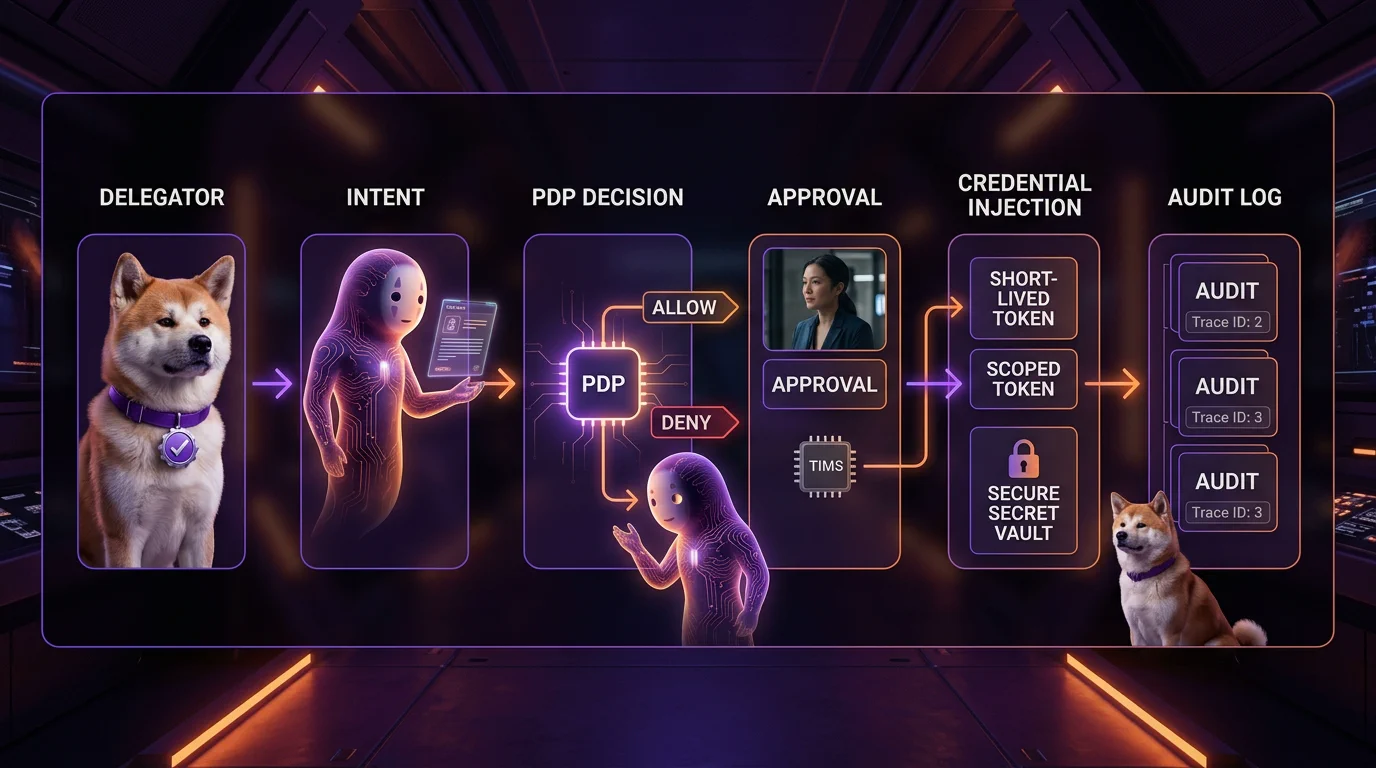
The secure pattern is straightforward: keep credentials away from the LLM, evaluate policy before execution, and issue narrow credentials only for approved operations. The model plans; infrastructure enforces.
A robust runtime flow looks like this: human delegator context is attached to the request, agent proposes a tool call with intent, PDP evaluates policy, high-risk calls trigger approval/JIT, then execution proceeds with server-side secret injection and short-lived scoped tokens. Every step is logged, and revocation can immediately block future calls (and, where applicable, invalidate active short-lived credentials).
This is how you keep server-side credential injection useful without turning it into a blind privilege escalator. OAuth 2.0 is still valuable for identity and token exchange, but least privilege depends on runtime scoping and policy decisions, not just initial connection setup.
Generated tooling increases operational blast radius unless audit quality increases with it. You need enough data to reconstruct "who asked, what was attempted, why it was allowed, and what happened."
Use a concrete audit checklist:
| Audit field |
Why it matters |
| Timestamp (request + decision + execution) |
Reconstruct sequence and latency |
| Delegating human identity |
Establish accountable principal behind agent action |
| Agent/session identity |
Distinguish autonomous runs and replay contexts |
| Tool name + OpenAPI operationId/path |
Identify exact generated capability used |
| Resource identifiers/tenant scope |
Confirm boundary of impact |
| Declared intent/reason |
Support policy reasoning and post-incident review |
| PDP decision (allow/deny/conditional) + policy version |
Prove which rule set made the decision |
| Approval metadata (approver, time, ticket) |
Validate JIT/destructive-action controls |
| Credential mode (injected/scoped token TTL/scope) |
Verify least-privilege execution conditions |
| Execution outcome (success/failure, error class) |
Detect abuse patterns and operational issues |
| Correlation/request ID |
Join logs across MCP server, PDP, API gateway, backend |
When an incident happens, this record set is the difference between "we think the agent did X" and a defensible, replayable timeline.
Frequently asked questions
Should we expose every OpenAPI endpoint as an MCP tool by default?
No. Start with explicit allow-listing and risk classification. Full auto-exposure is fast, but it often includes admin/destructive endpoints that were never intended for autonomous use.
Isn't OAuth 2.1 enough for controlling agent actions?
OAuth 2.1 is necessary for secure delegated access, but it is not sufficient for intent-aware authorization. You still need per-call policy evaluation to enforce least privilege at runtime.
What is the difference between endpoint filtering and runtime policy?
Endpoint filtering is a static build-time control that decides which tools exist. Runtime policy is a live execution-time control that decides whether a specific call is allowed under current context.
Why does human delegator context matter?
Without delegator context, actions become attributable only to "the agent." Delegator identity ties actions back to accountable humans and enables role- and relationship-aware policy decisions.
Which tool classes should require approvals?
High-risk classes such as delete, revoke, export, and transfer should generally require approval or JIT elevation, especially in production or customer-data environments.
How do we keep secrets away from the LLM while still letting tools execute?
Use server-side credential injection and short-lived scoped credentials issued only after PDP authorization. The model never receives raw long-lived secrets.
What should we log first if our audit stack is immature?
Start with decision-critical fields: delegator identity, tool invoked, target resource, PDP decision, policy version, approval metadata, and execution outcome. Those fields give immediate forensic and governance value.