If your team is letting agents draft OpenAPI specs, you now have a speed multiplier and a risk multiplier in the same pipeline. The core issue is that machine-generated APIs can be syntactically valid while still violating naming, versioning, auth, and error-handling standards that your downstream agents depend on. As Postman's governance breakdown analysis explains, governance programs fail when standards live outside day-to-day delivery and never become real-time enforcement.
The solution involves more than just adding documentation. It requires a connected control loop from design-time governance to runtime authorization.
Why this problem is different in the agent era
Human developers can sometimes attempt to compensate for inconsistency by reading docs, asking teammates, or inferring intent from context. Autonomous agents consume contracts literally and operate at machine speed, though they can be designed to handle some inconsistencies through fallback mechanisms. That means spec drift, ownership gaps, and ambiguous version metadata stop being "technical debt" and become runtime failures.
The Postman write-up argues that durable programs run governance where work already happens (authoring + CI + catalog), then keep ownership and conformance visible in a live inventory rather than periodic audits. That design becomes even more critical when APIs are generated by agents and later surfaced as callable tools.
In parallel, MCP ecosystem discussions increasingly separate identity proof from action control: Apigene's MCP authentication patterns article emphasizes that authentication alone does not answer which specific tools an agent should be allowed to invoke.
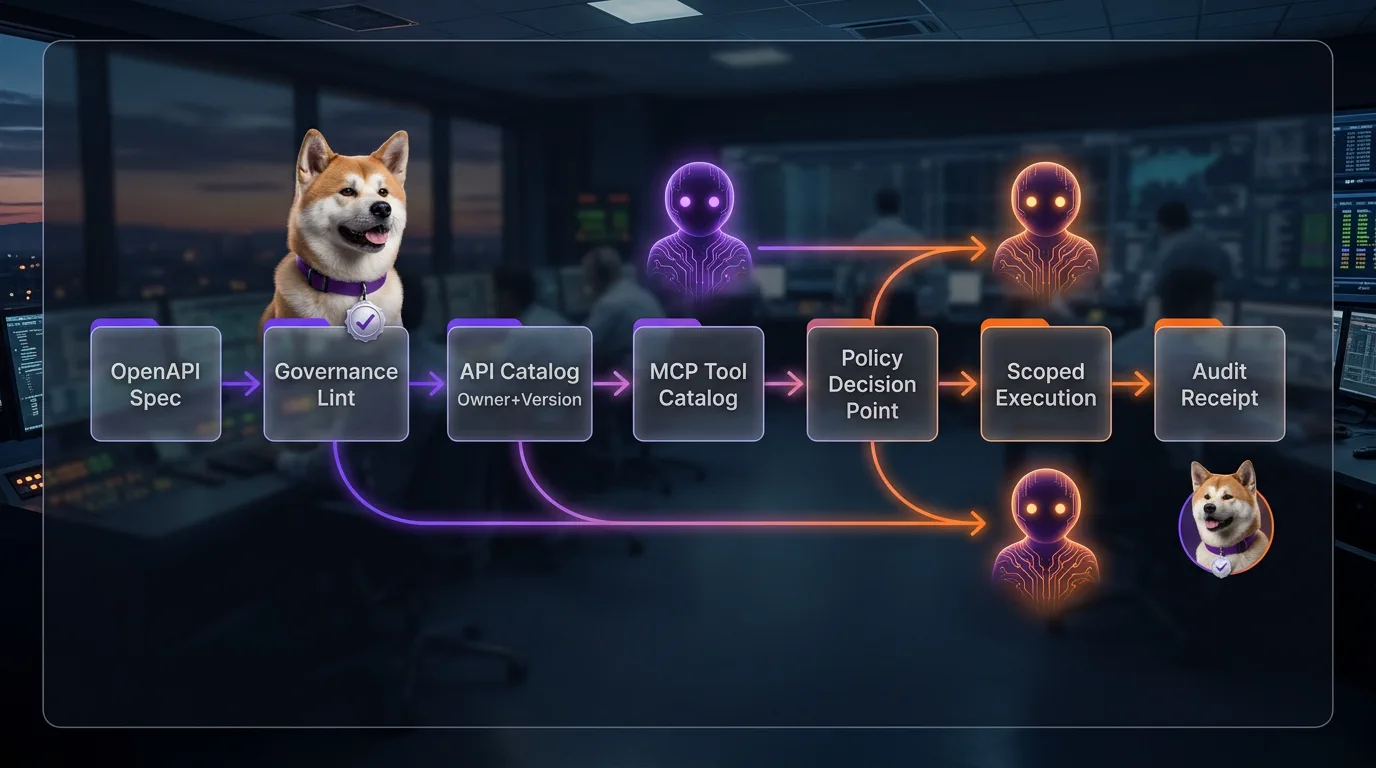
Use this pipeline as a non-negotiable baseline:
Agent-authored OpenAPI spec
Treat generated specs as untrusted drafts, not deployable artifacts.
Governance linting and policy gates
Run rules in-editor and in CI. Enforce semantic standards: naming, error envelopes, auth scheme declarations, pagination conventions, deprecation strategy, and backward compatibility checks.
Governed API catalog with ownership + version metadata
A spec is not "governed" until it has explicit owner, lifecycle state, version lineage, and dependency links.
MCP tool catalog generation
Only promote catalog-approved endpoints into tool definitions. Tool metadata should include risk class, data sensitivity, required scopes, and owner escalation path.
Runtime authorization decision per tool call
Every call must be evaluated with subject, agent identity, tenant context, tool action, resource instance, session attributes, and risk signals.
Constrained execution credentials
Mint short-lived, least-privilege credentials per call or session slice. Never let long-lived broad tokens sit inside agent memory.
Audit receipt
Emit immutable decision receipts that bind request context, policy version, decision result, execution identity, and outcome status.
This model is highly effective for scaling when both API production and API consumption are increasingly agent-driven.
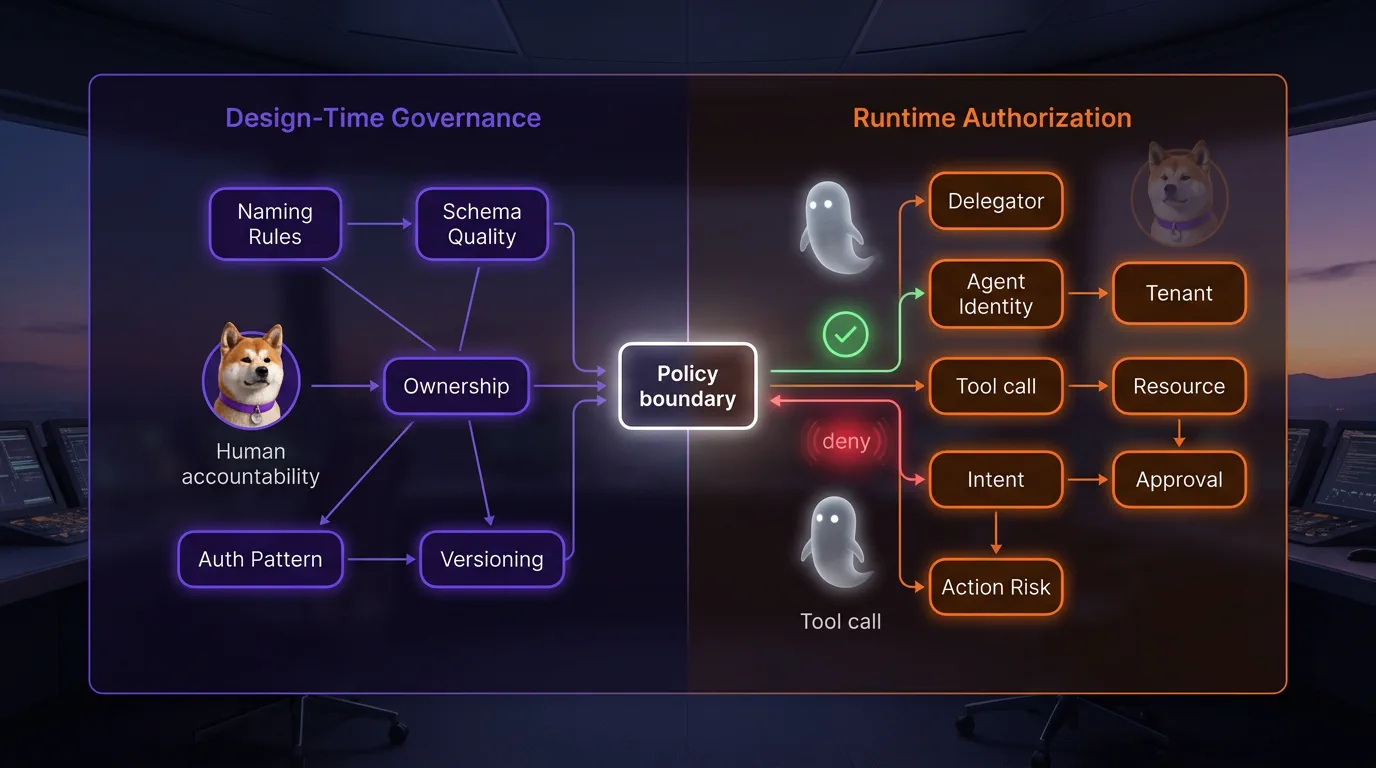
Design-time governance controls that must exist before runtime
Design-time controls should be implemented as engineering constraints, not documentation aspirations:
- Spec quality gates: block merge on rule violations, undocumented breaking changes, or missing auth/security schemas.
- Ownership completeness: require technical owner, business owner, and on-call group for every API and toolable operation.
- Version integrity: enforce semantic versioning conventions and explicit deprecation windows.
- Toolability checks: validate operation IDs, deterministic input schemas, and safe idempotency metadata before MCP exposure.
- Change-risk classification: auto-tag operations by write/destructive potential and regulated data exposure.
- Catalog eligibility policy: only "green" APIs can be transformed into tool catalog entries.
This is aligned with the broader governance lesson from Postman's article on successful programs: enforcement must be embedded in authoring and CI, not deferred to review boards.
At runtime, the control question is: should this specific agent invoke this specific tool right now under this context? That requires more than OAuth login state.
A strong runtime model includes:
- Per-tool policy checks on each invocation.
- Explicit delegation so authority between human users and agents is auditable.
- Context-aware decisions using tenant, purpose, risk class, and session state.
- Just-in-time credentials with narrow scope and short TTL.
- Step-up controls for high-risk operations (approval, re-consent, or stronger auth).
- Continuous logging of decisions and outcomes, not just authentication events.
The operational reality described in Apigene's MCP authentication analysis is that teams succeed when they centralize auth/authz enforcement in gateway or control-plane patterns instead of hand-rolling fragmented logic per server.
Compact comparison: OPA vs Cedar vs OpenFGA in tool-call authorization
| Engine |
Primary model strength |
Typical runtime role for tool calls |
Practical tradeoff |
| OPA |
General policy-as-code (Rego) across infra + app contexts, commonly used for ABAC/RBAC-style decisions as summarized in this open-source authorization roundup |
Evaluate contextual allow/deny per call at gateway/service boundaries |
Very flexible, but policy authoring/operations can be complex at scale |
| Cedar |
Fine-grained authorization language with analyzable policies; integration options vary by ecosystem, including Java bindings in the official cedar-java repository |
Fast, explicit principal-action-resource decisions for application/tool domains |
Strong modeling clarity, but adoption depends on your language/runtime ecosystem |
| OpenFGA |
Relationship-centric ReBAC (Zanzibar-style) for graph-like permissions in the same roundup's model comparison |
Resolve "who can do what on which object" for shared, hierarchical, multi-tenant resources |
Excellent for sharing graphs; often paired with other policy layers for rich context rules |
| Runtime control plane (orchestration layer) |
Policy distribution, identity binding, decision routing, logging, approval hooks |
Calls one or more engines, enforces per-call checks, mints constrained credentials, emits audit receipts |
Adds architecture complexity, but is usually mandatory for multi-agent production systems |
Implementing the control plane with Permit.io (after governance fundamentals are in place)
If you adopt Permit.io in this pattern, anchor implementation to documented capabilities.
The Permit hybrid architecture overview describes OPAL for policy distribution and real-time updates, and PDP for decision making, alongside local decisioning patterns and policy engine flexibility. The same page states support for OPA and Cedar-based policy engines through its PDP model. For agent tooling specifically, the Permit MCP Gateway architecture docs describe a proxy model where each tool call is checked through policy, with authentication, consent flow, and decision logging integrated. The Permit PDP overview further positions PDP placement close to services for availability and low-latency authorization evaluation.
In practice, this means you can keep your design-time governance stack product-agnostic, then use Permit as runtime enforcement and policy operations infrastructure where per-tool decisions, delegated identity, and auditability must converge.
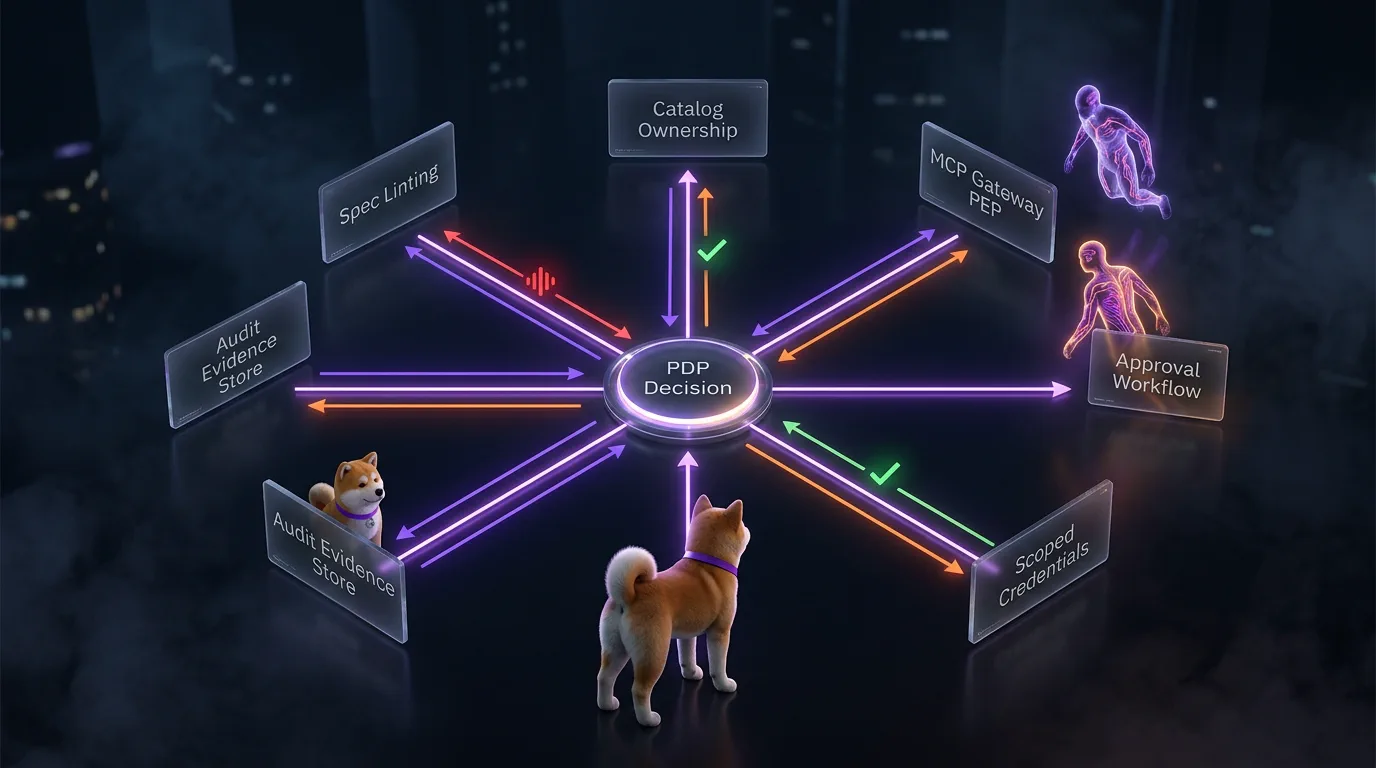
Reference architecture
A production-ready reference architecture for agent-callable APIs should look like this:
The critical architectural rule: no direct tool execution path should bypass policy decisioning and credential brokering.
Test and audit requirements for policy engines and integrations
You need tests at three layers: policy correctness, integration correctness, and forensic correctness.
For policy correctness, require unit tests for allow/deny matrices, regression tests for policy version changes, and property-based tests for edge contexts such as tenant boundary crossing and conflicting role inheritance. For integration correctness, run contract tests on gateway-to-engine calls, negative tests for missing/expired credentials, and chaos tests for engine/network degradation to verify fail-closed behavior on sensitive operations. For forensic correctness, verify that every tool call yields a linked receipt containing actor, delegated principal, policy version/hash, decision rationale metadata, credential scope, and execution outcome.
Audit-readiness should be measurable: deterministic replay of sampled decisions, evidence that suppressed governance findings are tracked and approved, and proof that runtime controls align with design-time API/tool metadata. If you cannot reconstruct why a high-risk tool call was allowed, your system is observable but not governable.
Frequently asked questions
How is API governance for agents different from normal API governance?
Agent pipelines increase both generation volume and invocation volume, so manual review processes collapse faster. Human consumers can sometimes compensate for inconsistent contracts, while agents are generally more prone to failures on ambiguity unless explicitly engineered for fallback behavior. That is why governance must be machine-enforced at authoring and CI, then carried into runtime authorization. In short, agents force you to connect design-time and runtime controls as one system.
Why isn't OAuth enough for MCP tool security?
OAuth is primarily a protocol for authorization, providing a framework for obtaining access tokens and defining scopes and permissions to access resources on behalf of a user. Authentication is typically handled by protocols like OpenID Connect, which is an identity layer on top of OAuth 2.0. Tool-call safety still requires per-action authorization with policy and risk inputs, because scopes alone do not enforce every contextual constraint. This is consistent with MCP auth discussions that separate authentication from authorization in real deployments. Without per-call decisions, authenticated agents can still overreach.
Should we choose one engine (OPA, Cedar, or OpenFGA) for everything?
Not always. Many teams combine engines by problem shape: ReBAC graph checks in one layer and contextual policy checks in another. The key is a runtime control plane that normalizes decision requests and logs outcomes consistently. Engine purity matters less than decision consistency and auditability.
What is an audit receipt and why does it matter?
An audit receipt is the structured evidence record for one tool call from request through execution. It should include identities, policy version, decision output, scoped credential attributes, and execution status. Receipts let you prove control operation during incidents, compliance reviews, and postmortems. Without receipts, you have logs but weak accountability.
Where should constrained execution credentials be issued?
Issue them at runtime in a credential broker or gateway-adjacent service, not inside agent prompts or long-lived config. Credentials should be scoped to a single tool/action set and short-lived by default. Revocation and rotation must be automated and observable. This reduces blast radius when prompts or sessions are compromised.
When should a governed API become agent-callable?
Only after it passes governance linting, has explicit ownership, carries version/lifecycle metadata, and is mapped to a tool risk class. It should also have a tested authorization path and a verified audit receipt path. If any of these are missing, keep it in API catalog state but do not publish it to the MCP tool catalog. "Callable" is a security state, not just a discoverability state.