

Loading
Teams · Security
Security writes the access policy. Engineering implements it in fifty places, slightly differently each time. Permit puts the policy in one layer that every service and agent has to ask, and gives you the log of every answer.
“At Epsagon (acquired by Cisco) we are no strangers to the complexity of microservices. Access control demands of microservices are never-ending, so they require a modern stack that can quickly adapt to the most demanding tech and security needs.”
 Ran RibenzaftEpsagon CTO, Cisco
The approved access model and what the application actually does diverge with every release, and nobody can diff them.
Service accounts, API keys, and broad roles pile up, because narrowing them always requires a code change nobody has time for.
Agents act through human credentials or long-lived tokens, so a single prompt injection gets whatever those credentials can reach.
After an incident, the first question is who could access what, and why. Application logs rarely say.
Authorization becomes a control you own and can inspect, instead of an implementation detail spread through the code.
Services, gateways, and agents call the same decision points, so the policy you review is the policy that runs.
RBAC, ABAC, and ReBAC grant access per resource and per condition, instead of per system.
Through the MCP Gateway, agents never hold real credentials. They act on a person’s live permissions, and revoking the person revokes the agent on its next call.
Approval flows require sign-off before elevated access or high-risk actions, including actions requested by agents.
Policy guards decide who can change which policies, and with GitOps enabled, policy changes land in your Git repository with their history.
Every decision is recorded with its reason and forwardable to your SIEM, so an investigation starts with facts.
An agent tries a destructive action beyond what its user consented to. Illustrative data.
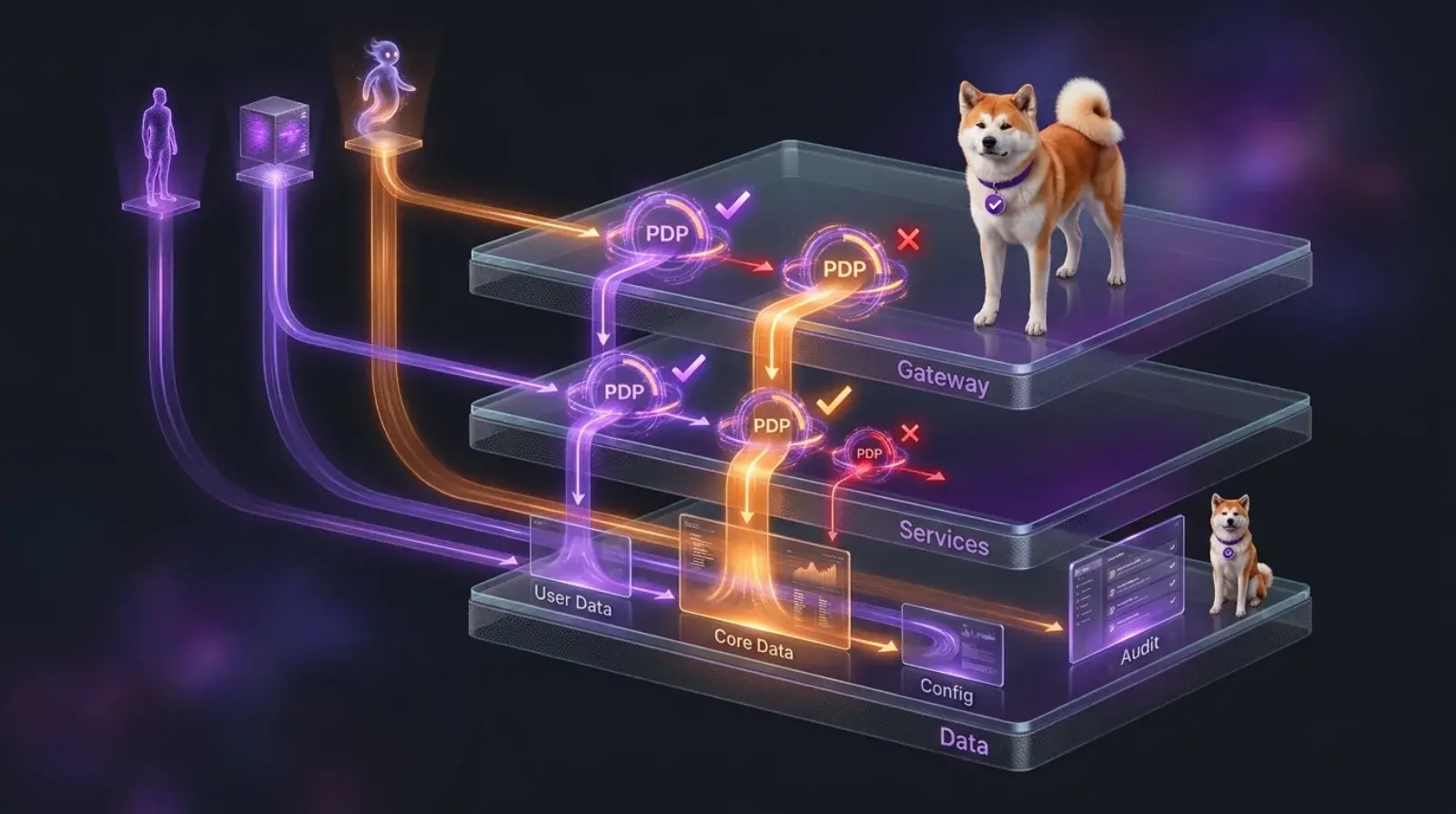
One agent action, four enforcement points
“At Granulate we optimize our customers’ most critical systems; as a result, getting access control right is of the highest importance. Full stack permissions as a service allows our developers to focus on their core product. I was extremely impressed both by Permit.io’s technology and its dedication to customer service.”
 Tal SaiagFounder & CTO, Granulate
By replacing broad, standing access with default-deny policies evaluated on every request. A compromised account, token, or agent can reach only what policy allows for that specific request.
The MCP Gateway gives each agent an identity bound to the person it acts for, their consent, and its declared intent. Every tool call is checked against policy, and upstream credentials stay vaulted in the gateway.
Policy guards restrict which people and teams can change which policies. With GitOps enabled, policy changes are committed to your Git repository, so they can be reviewed like any other code.
Yes. Decision logs include the user, action, resource, outcome, and reason, and can be forwarded to your SIEM or SOC tooling.
Permit holds a SOC 2 Type II attestation and runs annual third-party penetration tests. Decision points run inside your own network and keep answering from cached policy if the control plane is unreachable. See the Trust Center for the full program.
Tell us what you are authorizing and where it runs. We come to the call with a model of how Permit would enforce it.