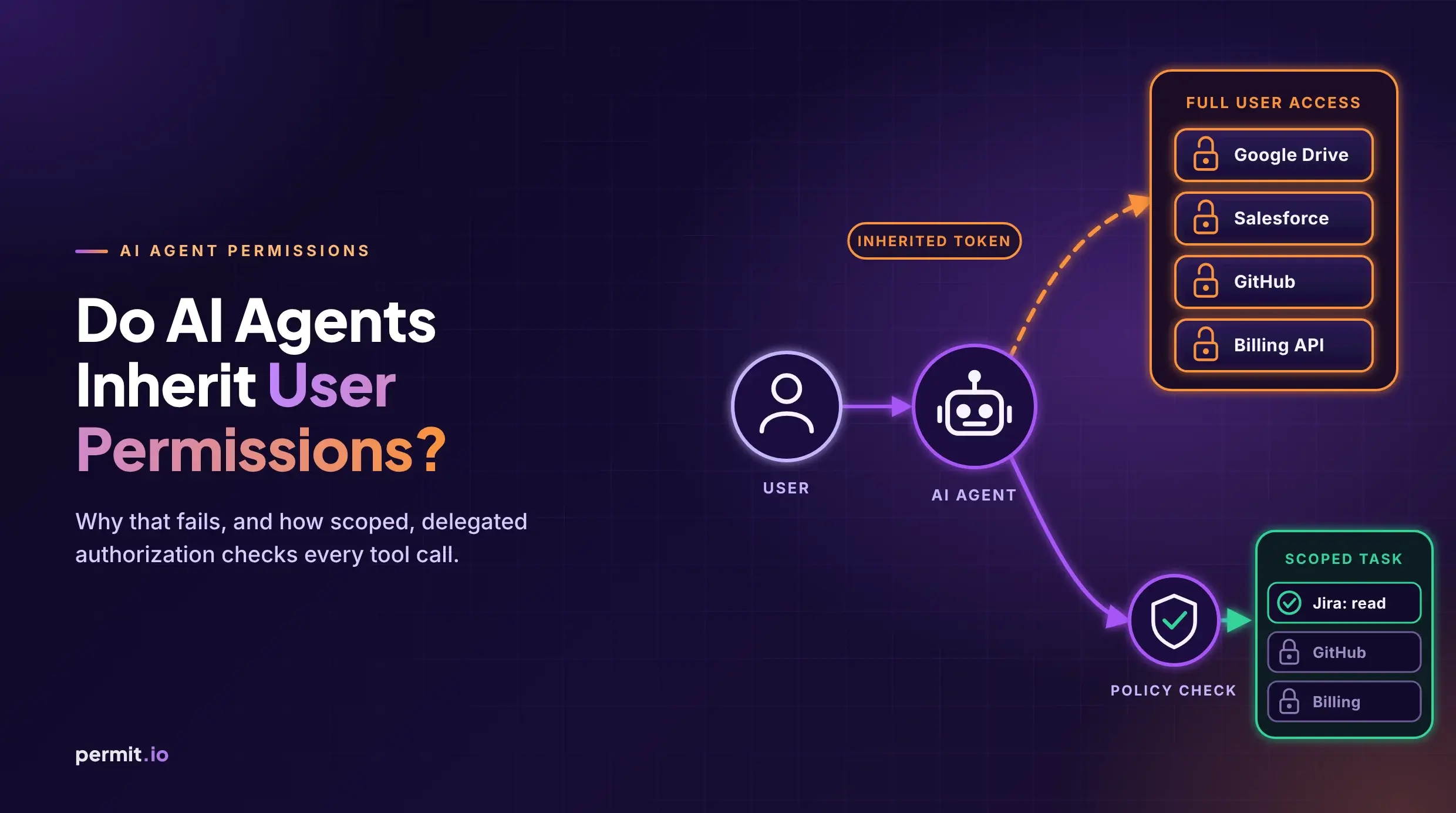
MCP database servers now sit in the blast radius of production data, production credentials, and production automation. That makes them control-plane components, not "just integration glue." If they expose tool execution without identity and policy, they create a direct path from anonymous network access to privileged backend actions.
MCP database servers are high-consequence control planes
An MCP server that fronts a database is effectively a broker for sensitive operations: discovery, query, metadata access, and mutation. Even if the database itself has strong auth, the MCP layer can become the weak link if it executes with a service identity and does not enforce caller identity. In practical terms, MCP tool-call authorization must be treated like API gateway authorization, not optional middleware.
Security teams should model MCP as a policy enforcement point with explicit trust boundaries. If the server can call privileged APIs, then every tool must have authentication, authorization, and audit semantics before exposure. "Internal-only" assumptions are brittle once agents, browsers, CI jobs, and developer machines are all potential callers.
The confused deputy pattern appears when a low-privilege or unauthenticated caller can induce a high-privilege component to act on its behalf. In MCP, that deputy is the server process, and its delegated authority is usually a token or service account to upstream systems. Without per-request identity and policy checks, the MCP server launders caller intent through its own privileges.
That is why missing authentication is not just an access-control bug; it is a trust-transitivity bug. You are not only exposing tools, you are exposing the authority behind those tools. This is exactly where MCP database authorization has to separate caller rights from backend service credentials.
Why binding to 0.0.0.0 is unsafe without runtime policy
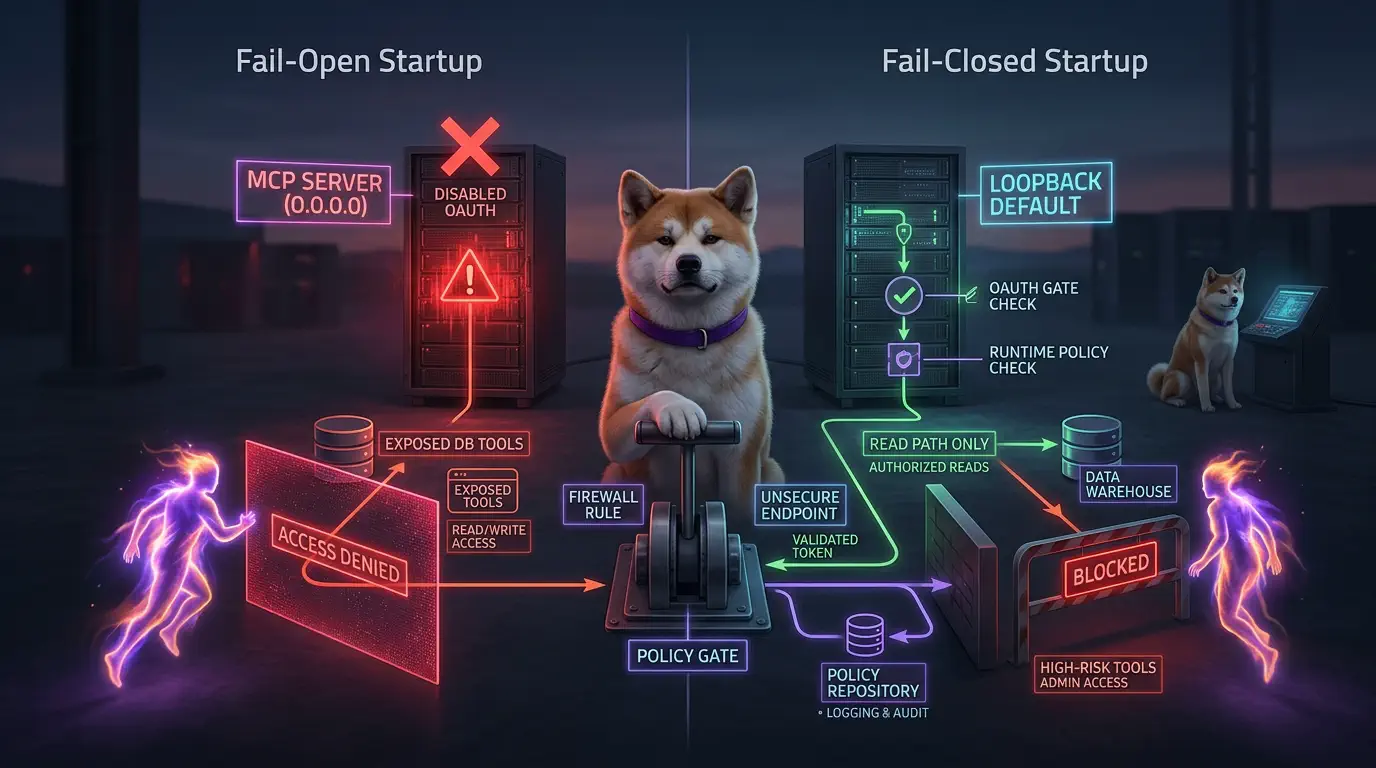
Binding to 0.0.0.0 is not inherently wrong, but it is dangerous when paired with permissive defaults and no runtime guardrails. It expands reachability to any routable interface, which multiplies accidental exposure risk in cloud, container, and developer-network environments. If authentication or policy loading fails, the server can become remotely callable in a single bad deploy.
A safe model is: network exposure must be intentionally enabled, identity must be mandatory, and policy must be present at startup. If any of those prerequisites are missing, the process should not listen on non-loopback addresses. Reachability should be a controlled state, not a default state.
Design pattern: fail closed when OAuth is unavailable
For OAuth for MCP deployments, startup should include a hard preflight: issuer config valid, JWKS reachable, audience configured, and policy engine healthy. If those checks fail, the server should refuse to start in network mode. That is the essence of a fail-closed MCP server.
This is especially important when frameworks allow auth=None behavior that still registers tools. Treat "auth disabled" as a special case only for strictly local, loopback-only development mode with explicit operator intent. In all other modes, no auth should mean no service.
CVE-2026-49257 and mcp-pinot: what actually broke
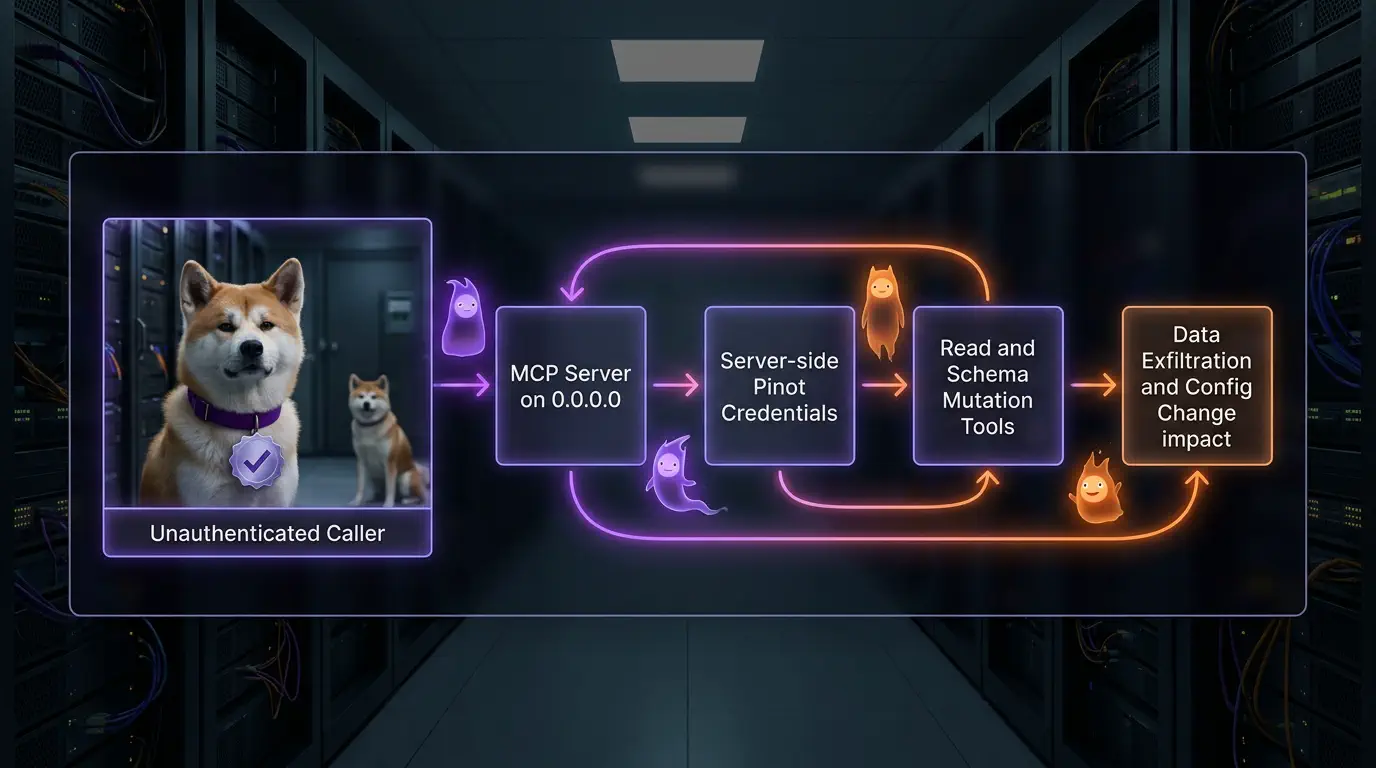
The GitHub advisory for GHSA-73cv-556c-w3g6 in startreedata/mcp-pinot describes unauthenticated MCP tool invocation when oauth_enabled=False combined with a 0.0.0.0 bind, affecting versions up to 3.0.1 and patched in 3.1.0. The advisory also documents the confused-deputy impact: tool calls were proxied with server-side Apache Pinot credentials, enabling read and write operations depending on that service account's privileges. It explicitly notes behavior around FastMCP where tools were exposed without authentication when auth was not configured.
The NVD entry for CVE-2026-49257 classifies the weakness as CWE-306 (missing authentication for critical function), lists a CNA CVSS 3.1 base score of 10.0, and records publication on June 18, 2026 with last modification on June 23, 2026. NVD's description confirms the same core conditions: network exposure, no auth, and privileged proxying to Apache Pinot. This is a textbook case where MCP defaults created internet-reachable authority without identity checks.
A broader analysis of MCP auth attack surface from WorkOS reinforces the operational lesson: optional auth plus accidental exposure is now a recurring incident pattern, not a hypothetical. The practical takeaway is to make secure defaults mandatory before MCP reaches production networks.
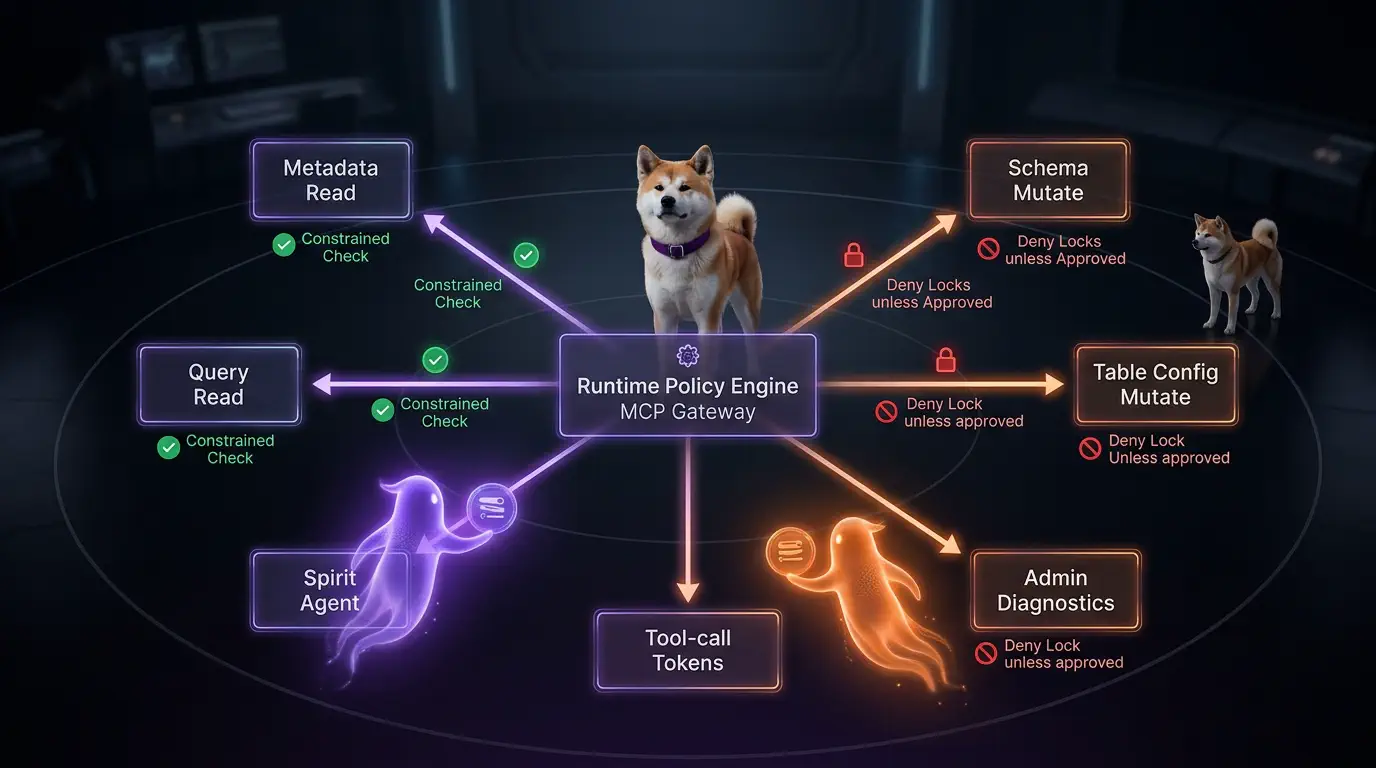
A robust MCP policy should separate capabilities by risk domain, not just by "authenticated vs unauthenticated." At minimum, define distinct permission sets for list/read/schema/table-config/admin classes so that discovery does not imply mutation.
- List tools: table and metadata enumeration should require authenticated principals and scoped visibility to allowed namespaces.
- Read tools: enforce a read-only tool policy with query-shape constraints, row/column controls, rate limits, and per-table allowlists.
- Schema tools: schema mutation permissions should be rare, workflow-gated, and usually limited to platform automation identities.
- Table-config tools: treat as change-management operations with approval paths and strong audit requirements.
- Admin/diagnostic tools: tightly restrict because they often leak topology, credential mode, or operational internals.
This gives you layered MCP database authorization that aligns with blast radius, not convenience.
At tool-call time, policy should evaluate more than role membership. A practical MCP database authorization model should evaluate identity, intent, trust level, resource, and action on every invocation:
- Identity: delegating human identity and executing agent identity.
- Intent: declared task or change purpose, not only raw tool name.
- Trust level: interactive trusted session vs unattended automation vs unknown caller context.
- Resource: cluster, database, schema, table, and column scope.
- Action: list, read query, schema mutate, table-config mutate, or admin diagnostics.
This is what prevents "can reach the MCP server" from becoming "can call every tool with backend credentials."
Implement authorization in two planes: first at MCP ingress (who can call which tool), then at backend execution (what that caller can do in Pinot). Do not rely on a single coarse token for everything. If you centralize policy, keep decision logs and denied-action telemetry as first-class signals for detection and incident response.
After these fundamentals are in place, you can use a policy gateway approach such as Permit MCP Gateway to externalize fine-grained authorization decisions and keep policy lifecycle separate from tool code. The value is consistency across MCP servers, explicit policy versioning, and faster rollout of least-privilege changes. But even with a gateway, startup must still fail closed when identity or policy dependencies are unavailable.
Audit requirements for forensic reconstruction
If an incident reaches production, responders need to reconstruct decisions quickly and unambiguously. Minimum MCP audit records should capture:
- delegating human identity and agent identity
- tool name/class and normalized query or mutation payload
- target resource (cluster, database, schema, table)
- policy version and matched rule IDs
- allow/deny decision plus rationale
- execution result metadata and correlation IDs
Without this chain, teams cannot confidently answer who did what, through which tool, under which policy, and why it was allowed.
Frequently asked questions
What makes CVE-2026-49257 more than a normal auth bug?
It combines unauthenticated access with delegated backend authority, which creates a confused deputy. That means attackers do not need direct Pinot credentials if the MCP server will execute on their behalf. The result is privilege transfer, not just endpoint exposure.
Why is CWE-306 the right classification here?
CWE-306 captures missing authentication on critical functionality, and these tools include query execution and configuration mutation. When critical operations are callable without identity, the system cannot enforce accountability or least privilege. That maps directly to the documented impact.
Is localhost binding enough if OAuth is disabled?
It is safer, but not universally safe. Browser-based localhost attack paths and local malware can still abuse permissive tool surfaces. Local mode should still use strict tool policy, reduced capabilities, and explicit operator awareness.
How should teams design a read-only tool policy for MCP databases?
Start with allowlisted tables, deny multi-statement execution, enforce SELECT-only parsing, and cap result size plus execution time. Add per-principal quotas and query templates where possible. Treat broad ad hoc SQL as an exception path, not default behavior.
Who should get schema mutation permissions?
Typically only controlled automation identities and a small set of platform engineers under change management. Human access should require strong auth, just-in-time elevation, and detailed audit records. Schema and table-config mutations should never be granted to generic agent identities by default.
What does a fail-closed MCP server check at startup?
It should verify OAuth configuration integrity, token verification readiness, policy engine connectivity, and required permission mappings. If any mandatory control is missing, it should refuse network startup rather than degrade into permissive mode. This prevents silent drift from secure to unsafe operation.