AI teams keep treating gateways like plumbing. They are not plumbing. They are control planes with keys, logs, routing authority, and often enough privilege to become the shortest path to total compromise.
The LiteLLM incident proved that point. As shown in Horizon3.ai's technical writeup of CVE-2026-42271 chained with CVE-2026-48710, what started as "authenticated command injection" in MCP test endpoints became unauthenticated RCE when combined with Starlette's BadHost behavior. And as described in InfoQ's BadHost coverage, the downstream exposure pattern wasn't narrow: AI agents, evaluators, LLM gateways, and MCP servers were all in scope.
What happened in the LiteLLM MCP RCE chain
The core bug in CVE-2026-42271 was a dangerous endpoint design: LiteLLM MCP test routes accepted stdio server configs that included command, args, and env, then spawned that command on the host during "test" operations. In other words, a web-facing service accepted process-execution instructions and executed them locally.
Initially, this looked "authenticated" because the endpoints were behind a proxy API key. But the chain mattered more than the individual CVE. According to Horizon3.ai's technical writeup of CVE-2026-42271 chained with CVE-2026-48710, Starlette BadHost (CVE-2026-48710) could bypass host-header-based assumptions and effectively remove that auth barrier in vulnerable deployments, producing unauthenticated remote code execution.
This is the modern AI security pattern: one "medium" framework parsing issue plus one "admin convenience" endpoint equals full compromise of the gateway host.
Why MCP test endpoints are high-risk even when authenticated
"Authenticated" is not a safety guarantee when the authenticated user can submit process definitions. If an endpoint allows inputs that map to OS-level execution (command, args, env), then the endpoint is a code execution primitive by design.
Even when only internal users hold keys, these endpoints remain high-risk because:
- keys leak, get reused, and appear in CI logs;
- agents and tools pass through credentials without human scrutiny;
- authorization is usually key-presence, not operation-safety;
- test paths are often less monitored than production inferencing paths.
This is why spawning stdio subprocesses from a web-facing service is a bad pattern. You are collapsing orchestration and execution boundaries into a single HTTP call path. If your policy model is "valid key = allowed to test tools," you have already over-granted.
The AI gateway blast radius
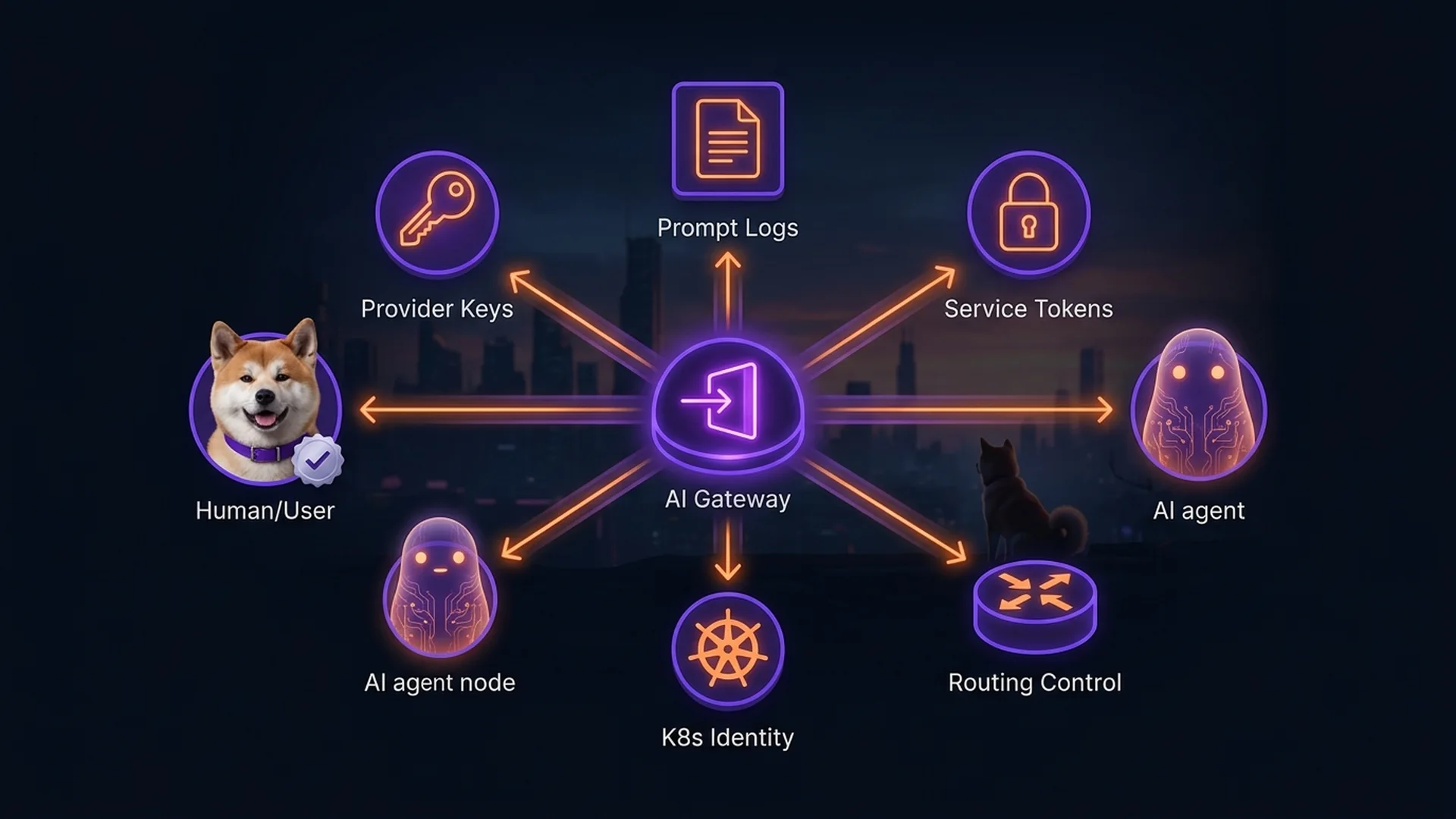
When an AI gateway falls, attackers do not just get shell access. They inherit control over the AI fabric.
The MCP gateway blast radius is the total set of assets and authority reachable after gateway compromise:
- Model provider API keys (OpenAI, Anthropic, Bedrock, and others) stored in env vars, secret managers, or runtime config.
- Prompt/response logs that may contain PII, internal prompts, secrets accidentally pasted into chats, and regulated data.
- Downstream service credentials used by retrieval services, vector DBs, eval stacks, and observability pipelines.
- Kubernetes service account tokens and in-cluster identity material mounted into pods.
- Routing authority over model traffic, including the ability to silently redirect requests, downgrade models, or exfiltrate responses.
The industry keeps treating this as "just another CVE." It is not. Gateway compromise is often equivalent to compromise of identity, data, and control plane in one move. That's why discussions in InfoQ's BadHost coverage about downstream AI systems matter so much: the exploit path is short, but the consequence graph is huge.
How to authorize MCP gateway management operations
This is where architecture has to change. Management operations on MCP gateways should be treated like IAM operations, not like ordinary API traffic.
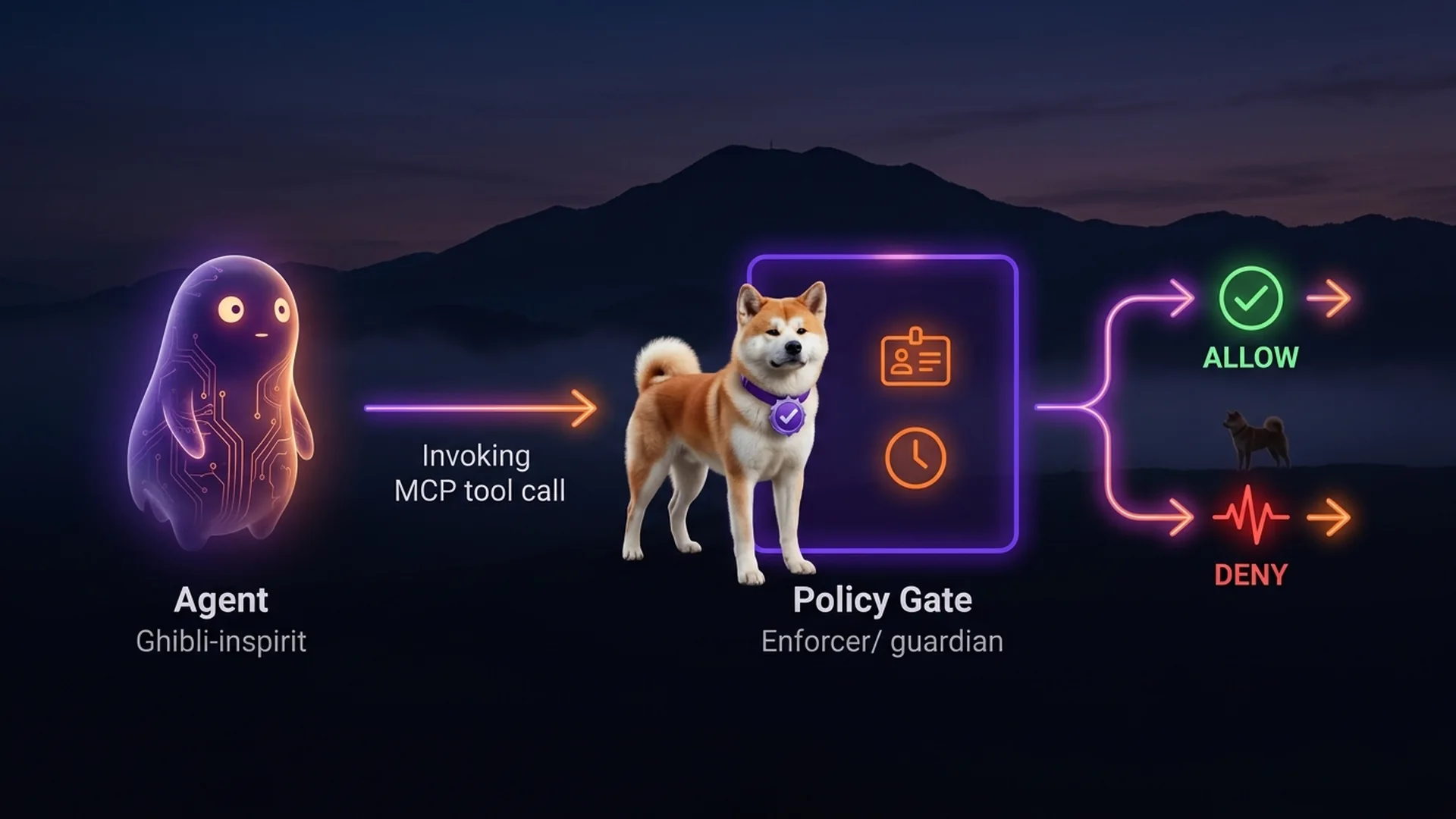
At this layer, action-time authorization means the policy check happens at the exact moment an MCP tool is invoked, against the real identity and runtime context, not just once at login or key issuance. And zero standing permissions for gateway management means admin-plane operations require explicit, time-bound grants instead of being permanently available to any bearer token.
This is the security model Permit.io pushes for: agent and MCP actions need action-time authorization, not broad gateway credentials. Permit MCP Gateway enforces role-gated tool access at invocation time, deny-by-default policy defaults, and per-invocation audit trails that capture identity, consent context, and policy decisions.
For this incident class, the mapping is direct:
- trust levels per tool class (read-only, diagnostic, execution-capable, privileged),
- deny-by-default on management and test endpoints,
- ephemeral elevation for break-glass testing,
- logs that explicitly show which human, agent, token, endpoint, and policy decision allowed or denied each action.
If you cannot answer "who executed this MCP test invocation and under what policy grant," your control plane is still flat.
Why a flat API key is not enough for an AI gateway
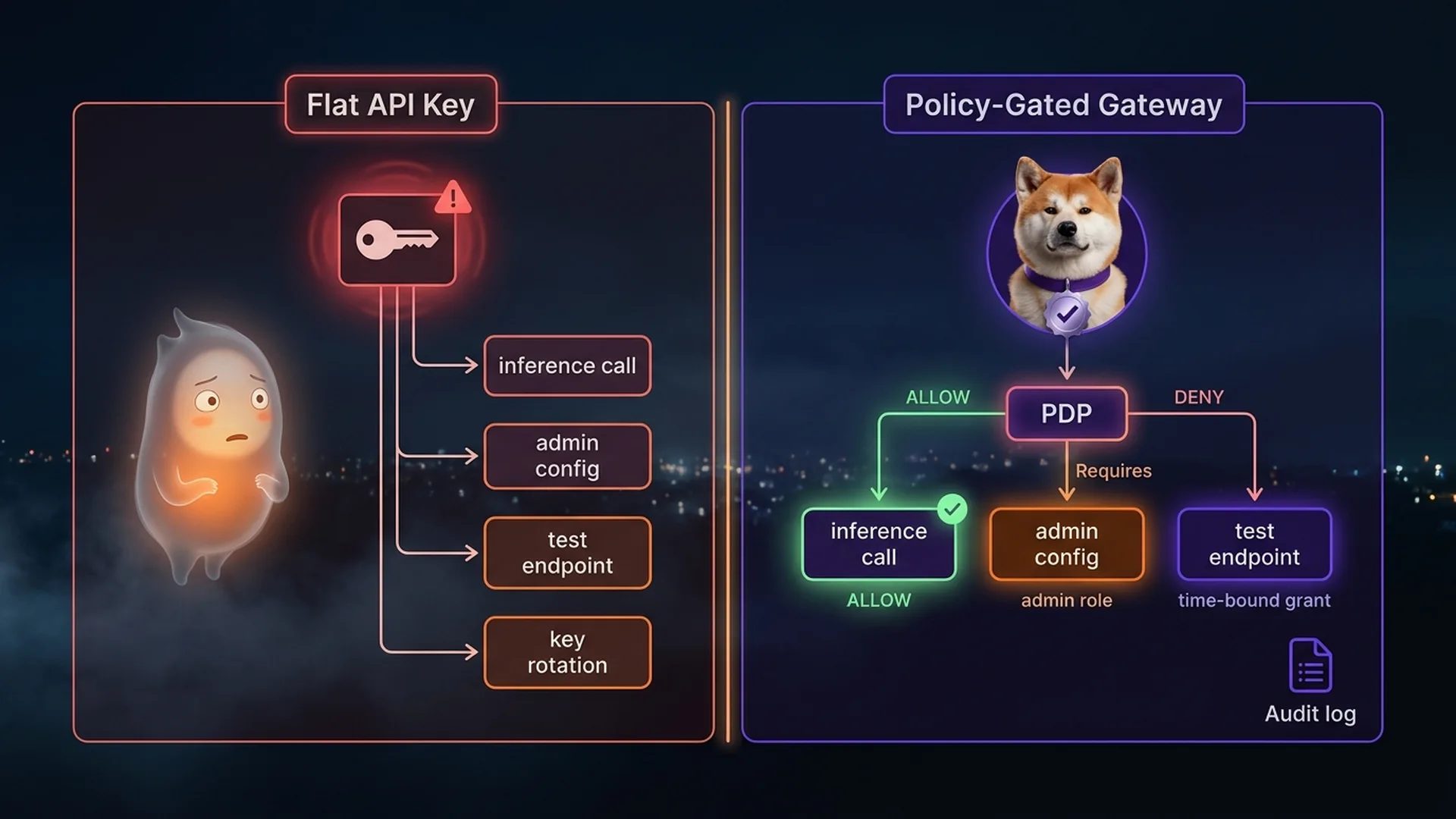
A flat API key with admin scope is a shared credential with a poetry degree. It sounds elegant, does everything, and says nothing useful during an incident.
Flat keys fail at least five ways in AI gateways:
- They authenticate callers but do not safely authorize specific operations.
- They cannot express contextual rules (time, environment, tool sensitivity, human approval).
- They are hard to revoke surgically without breaking legitimate traffic.
- They destroy attribution because many actors share one credential pattern.
- They encourage permanent privilege, which turns every leak into standing access.
Gateways need scoped, revocable, short-lived credentials plus per-action policy checks. "Has key" is authentication. "May run this tool now, in this environment, for this purpose" is authorization.
Incident response after AI gateway compromise
After suspected AI gateway compromise, containment must assume credential and routing compromise, not just host compromise.
Minimum response sequence:
- isolate gateway instances and freeze management/test endpoints;
- rotate model-provider keys, downstream tokens, and cluster credentials;
- invalidate service-account material and re-issue with reduced scope;
- review prompt/response logs for data exposure and legal/regulatory implications;
- verify model-routing integrity to detect tampering or covert redirection;
- replay authorization and invocation logs to reconstruct blast path;
- redeploy from known-good baseline with hardened policy boundaries.
Most teams under-rotate and over-focus on patching. Patch is mandatory, but it is not recovery. Recovery means reducing residual attacker access across every credential domain the gateway touched. For strategic context beyond this single chain, keep a running threat view such as the June 14 threat-research roundup, because gateway abuse is part of a wider identity-and-control-plane trend.
MCP gateway security checklist
- Treat MCP test/admin endpoints as privileged admin-plane surfaces.
- Require admin role (not merely "any valid API key") for tool testing operations.
- Enforce deny-by-default policy on all management actions.
- Separate admin plane from data plane at network and service-routing layers.
- Disable direct subprocess-capable test endpoints in internet-facing paths.
- Use short-lived, scoped credentials for gateway and downstream integrations.
- Implement action-time authorization for every privileged MCP tool invocation.
- Enforce zero standing permissions with explicit, time-bound elevation.
- Capture per-invocation audit logs with identity, endpoint, policy result, and consent context.
- Monitor for anomalous host headers, unusual test endpoint traffic, and subprocess spawns.
- Patch vulnerable LiteLLM and Starlette versions promptly, then verify exploit closure through validation testing.
- Run regular blast-radius drills: "if gateway is compromised, what can attacker control in 15 minutes?"
Frequently asked questions
What is the LiteLLM CVE chain?
The LiteLLM chain combines CVE-2026-42271 and CVE-2026-48710 to produce a more severe outcome than either issue alone. The first issue exposed command execution through MCP test endpoints that accepted stdio process configs. The second issue (BadHost in Starlette) enabled bypass of host-header-based access assumptions, which turned an authenticated path into unauthenticated RCE in affected deployments.
What is Starlette BadHost CVE-2026-48710?
BadHost is a Starlette host-header parsing and validation weakness that can break path-based security decisions when malformed Host values are accepted. In practical terms, middleware may evaluate a different path context than the one actually routed by the server. That mismatch can enable auth bypass and become a powerful link in exploit chains against AI systems — which is why InfoQ's BadHost coverage specifically named LLM gateways and MCP servers as affected downstream systems.
What is an AI gateway blast radius?
An AI gateway blast radius is the complete set of secrets, data, and control authority an attacker gains when the gateway is compromised. It commonly includes model-provider keys, sensitive logs, internal service tokens, Kubernetes identity material, and model-routing control. Because gateways sit between users, agents, tools, and model backends, their compromise is usually systemic rather than isolated.
Why are flat API keys insufficient for AI gateways?
Flat keys prove possession but do not enforce least privilege at operation level. They cannot safely differentiate between low-risk inference calls and high-risk management actions like tool testing or config mutation. In incident response, they also provide poor attribution and painful revocation patterns, which increases both detection time and recovery time.
How do you implement zero standing permissions for MCP gateways?
Start by classifying gateway and MCP operations into privilege tiers, then default all privileged tiers to denied. Require explicit, short-duration grants for admin actions, and enforce policy checks at invocation time with identity and context. Record each allow/deny decision so investigators can reconstruct who requested access, why it was granted, and what was executed.
What does incident response look like after AI gateway compromise?
Effective response starts with immediate containment of gateway admin surfaces and assumes secrets are exposed until proven otherwise. Teams should rotate model, service, and cluster credentials; validate routing integrity; and assess log-based data exposure. The final step is architectural: move from key-based broad trust to scoped, policy-driven, auditable authorization so the next exploit cannot inherit superuser power by default.