If an organization cannot reconstruct why an agent acted, who authorized it, and which policy version allowed it, then it does not have real auditability—it has scattered telemetry. The core thesis is simple: agent audit logs and MCP audit logs should be modeled as a causal commit log, not just a pile of tool traces.
Why Reconstructable Action History Matters
Most teams start with tool-call audit data because it is easy to collect. You can see that an agent called a tool, sent parameters, and got a response. But when an incident happens, leadership asks harder questions: who delegated authority, what consent was in force, which policy decision point approved it, and what obligations were attached.
That is where reconstructable action history becomes non-negotiable. A true audit history is not just chronological; it is causal. Every sensitive action should be linked to intent, authorization context, policy decision, and execution outcome inside a durable audit envelope.
Without causality, you cannot confidently support forensics, legal defensibility, or operational rollback. With causality, you can replay decision paths and prove that a decision was valid at the time it was made.
Logs Vs Traces Vs Transcripts Vs Compliance Records
These four artifacts are related, but they are not interchangeable:
- Logs record discrete events (for example, auth checks, tool invocations, failures).
- Traces connect runtime spans across services (for example via OpenTelemetry), great for performance and debugging.
- Transcripts capture interaction content (prompts, responses, intermediate reasoning artifacts where retained).
- Compliance records are curated, retained evidence designed to satisfy regulatory or contractual requirements.
For agent systems, you usually need all four. But only compliance-grade records, backed by immutable or tamper-evident logging patterns, answer governance questions with confidence. A trace can show latency spikes; however, it typically does not include sufficient information to independently verify that the correct policy version was applied under the right delegated authority at the exact decision moment.
Minimum Authorization Event Definition
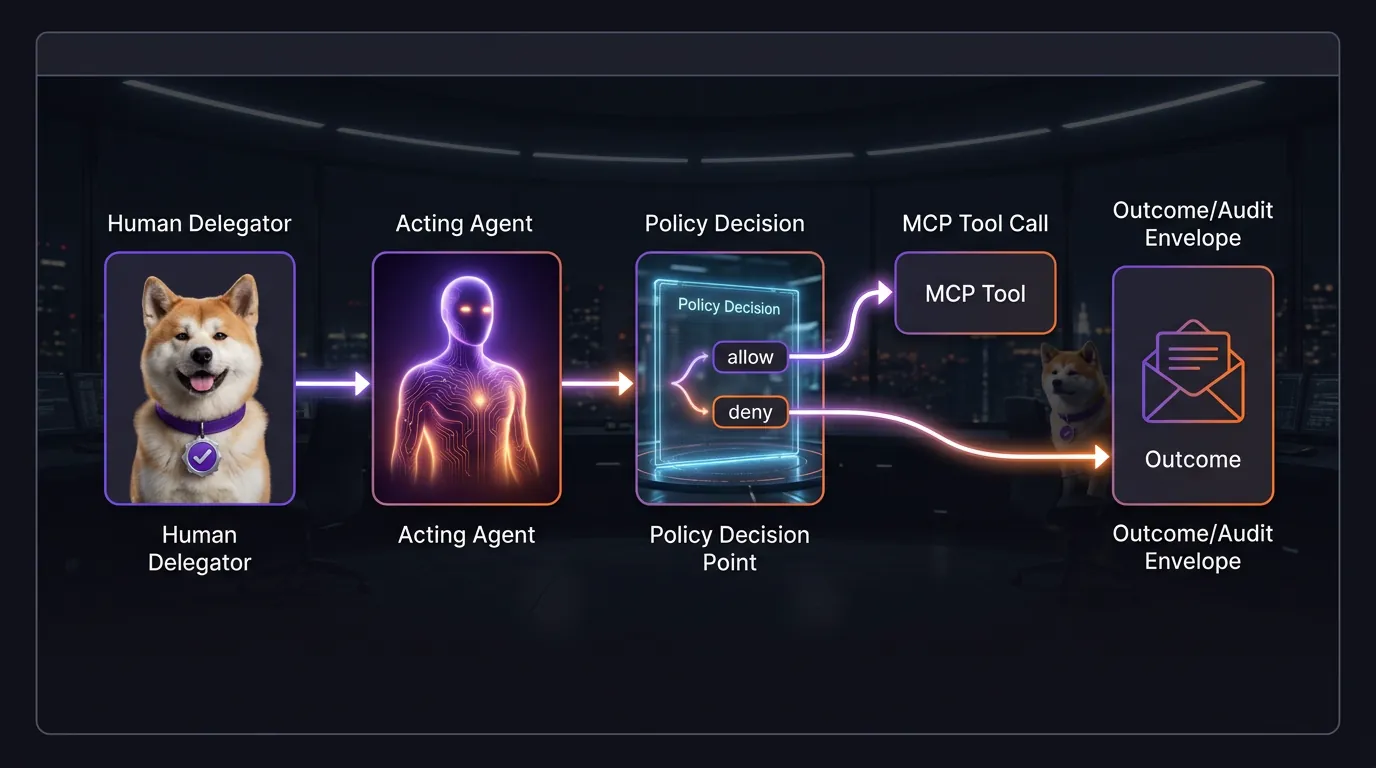
A minimum event for agent governance should bind identity, intent, decision, and outcome in one schema. This is the smallest useful shape for an audit envelope that can power investigation, replay, and compliance reporting.
| Field |
Why It Matters |
| event_id |
Unique anchor for the event record |
| occurred_at |
When the decision or action occurred |
| human_delegator |
Who granted or scoped authority |
| acting_agent |
Which agent actually acted |
| declared_intent |
What the agent claimed it was trying to do |
| consent_approval_state |
Whether user/admin approval existed and status |
| trust_level |
Runtime trust tier or risk class used in controls |
| tool |
Which MCP or non-MCP tool was invoked |
| resource |
Target object/system the action affected |
| policy_id |
Which policy set made the decision |
| policy_version |
Exact version used for deterministic replay |
| decision |
Allow or deny verdict from the policy decision point |
| obligations |
Conditions imposed on allow (masking, rate caps, approvals) |
| outcome |
Actual execution result (success/failure/partial) |
| correlation_id |
Groups related events in one workflow |
| causation_id |
Points to the event that directly caused this one |
{
  "event_id": "evt_01JZ9ZQ8X2K9V8M7Q1A3D4E5F6",
  "occurred_at": "2026-06-25T17:42:31.412Z",
  "human_delegator": {
    "id": "user_4821",
    "type": "employee",
    "role": "finance_manager"
  },
  "acting_agent": {
    "id": "agent_ap_invoices_v3",
    "session_id": "sess_7f3c1d",
    "runtime": "mcp"
  },
  "declared_intent": "Approve vendor invoice INV-88421 under delegated policy scope",
  "consent_approval_state": {
    "state": "approved",
    "approved_by": "user_4821",
    "approved_at": "2026-06-25T17:41:58.003Z"
  },
  "trust_level": "tier_2_verified_enterprise",
  "tool": {
    "name": "erp.invoice.approve",
    "protocol": "mcp",
    "server": "finance-tools-prod"
  },
  "resource": {
    "type": "invoice",
    "id": "INV-88421",
    "tenant": "acme-co"
  },
  "policy": {
    "id": "ap-approval-policy",
    "version": "2026.06.20.4"
  },
  "decision": "allow",
  "obligations": [
    "write_immutable_audit_record",
    "notify_requestor",
    "mask_vendor_bank_account_in_logs"
  ],
  "outcome": {
    "status": "success",
    "status_code": "200",
    "message": "Invoice approved"
  },
  "timestamps": {
    "decision_at": "2026-06-25T17:42:30.901Z",
    "tool_call_started_at": "2026-06-25T17:42:31.020Z",
    "tool_call_completed_at": "2026-06-25T17:42:31.389Z"
  },
  "correlation_id": "corr_approval_flow_01JZ9ZQ2W6",
  "causation_id": "evt_01JZ9ZNSR4R2D0P0Q7T8U9V1W2"
}
How Policy Decisions Fit Commit-Log Architecture
A commit-log model treats every authorization-relevant step as an append-only event: delegation, intent declaration, decision request, decision response, tool execution, and post-action attestations. This is exactly why commit-log patterns from distributed systems are becoming central to agent governance architecture.
The Kong engineering write-up on agentic commit-log architecture with Kafka and Kong AI Gateway illustrates the value of durable, replayable event streams for agent actions. In this design, the policy decision point is not an invisible side check—it emits first-class decision events that can be correlated with runtime execution and downstream controls.
Operationally, traces (including OpenTelemetry) remain essential and should be used to enrich the authorization commit log, rather than replace it. Then SIEM pipelines can consume normalized audit envelopes for detection rules, threat hunting, and long-term evidence retention.
Replay, Investigation, Revocation, And Compliance Use Cases
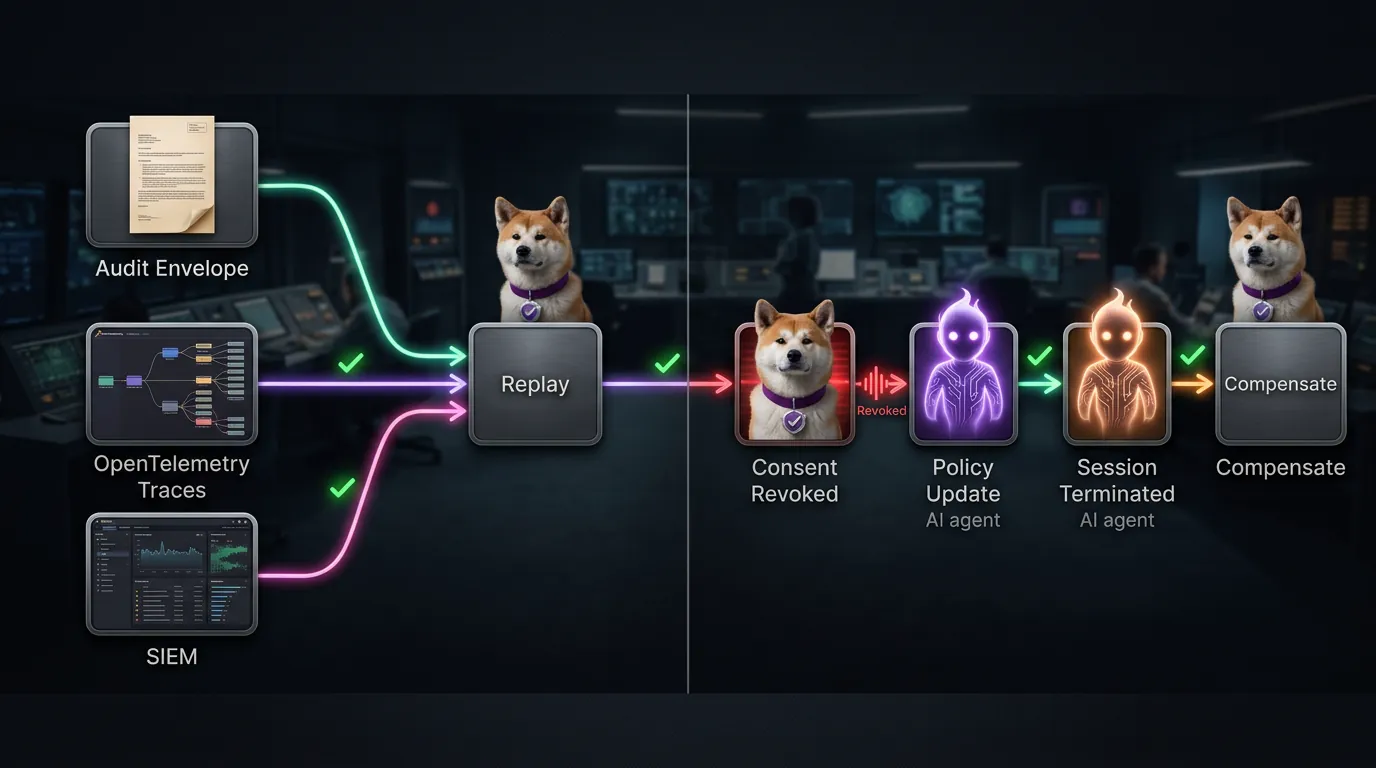
A causal commit log unlocks four concrete outcomes:
Replay
Re-run historical decisions against old or new policy versions to understand drift and blast radius before rollout.
Investigation
Reconstruct the exact chain from human delegation to agent action to external side effect, including every allow/deny checkpoint.
Revocation
Immediately identify which active sessions, tools, or delegated scopes must be revoked when trust drops or credentials are compromised.
Compliance
Produce evidence that is specific, timestamped, and policy-versioned—far stronger than generic tool-call audit lines.
This is where agent audit logs mature from observability artifacts into governance infrastructure.
Market Signals And Category Shift
The market is signaling a shift from “AI activity monitoring” to “AI authorization accountability.”
Together, these are signs of a category shift: from “did the tool run?” to “can we prove this action was authorized, bounded, and policy-correct?”
Where Permit MCP Gateway Fits
Permit MCP Gateway sits in the enforcement and evidence path where MCP tool access is actually decided and observed. The Permit MCP Gateway announcement frames this as centralized policy control for MCP-connected tools, while the six-layer MCP gateway model describes how policy, identity, mediation, and governance stack together.
In a commit-log architecture, this position is strategic. Permit MCP Gateway can emit structured authorization events (with policy id/version, trust level, obligations, and outcomes) that become the canonical audit envelope for MCP audit logs and broader agent audit logs. That gives teams a practical bridge between tool mediation, policy decision point outputs, SIEM ingestion, and compliance reporting—without treating tool traces as the final source of truth.
Frequently asked questions
What should AI agent audit logs contain?
At minimum, include actor identities (human delegator and acting agent), declared intent, policy id/version, allow/deny decision, obligations, and actual outcome. You also need correlation and causation IDs so events can be reconstructed as a chain rather than isolated lines. Timestamps for decision time and execution time should both be recorded.
How do I audit MCP tool calls?
Treat each MCP tool call as part of a broader authorization event, not just a runtime invocation record. Capture pre-call policy decisions, the tool and resource targeted, and post-call outcomes in the same causal graph. This turns MCP audit logs into evidence-grade records instead of simple execution telemetry.
How do I prove why an agent was allowed to act?
Store the decision artifact from the policy decision point with the exact policy id and version used at runtime. Link it to the delegator, agent identity, declared intent, and consent state in one audit envelope. With those links, you can show both who authorized and which rule authorized the action.
Why are agent traces not enough for compliance?
No—traces are necessary for runtime diagnosis but insufficient for governance proof on their own. They explain service flow and timing, not full authorization semantics. Use traces (for example via OpenTelemetry) as enrichment around a dedicated authorization commit log.
How can teams reconstruct what an agent did and why?
Teams need causally linked events that connect delegation, intent, decision, execution, and outcome with correlation and causation IDs. In practice, that means replaying the commit stream by workflow or session identifiers, not scanning disconnected logs by timestamp. When policy ids, versions, and obligations are attached to each decision, reconstruction becomes deterministic instead of interpretive.
Where should authorization decisions appear in an agentic commit log?
Authorization decisions should be recorded as first-class events before protected tool execution, and each execution event should reference the decision that allowed it. This ordering preserves proof that policy evaluation happened prior to side effects and makes incident replay straightforward. Decisions should never exist only as transient runtime checks or isolated debug logs.
How do SIEM systems fit into this model?
SIEM should consume normalized authorization events and causal links, not only raw application logs. That enables higher-confidence detections like “agent action without matching approved delegation event.” It also improves incident response by making identity, decision, and action relationships queryable.
Can we replay historical decisions after policy changes?
Yes, if you preserve immutable decision context including policy version and relevant inputs. Replay lets you compare “decision at time of action” with “decision under current policy” to measure drift. This is crucial for safe policy evolution and post-incident analysis.
What is the difference between tool-call audit and an audit envelope?
Tool-call audit usually captures invocation details: what tool ran, with which parameters, and what returned. An audit envelope wraps that with governance context: delegation, intent, consent state, policy decision, obligations, and causality. The envelope is what makes records reconstructable and compliance-ready.