

Loading
2938 Members
 Join Permit's Slack
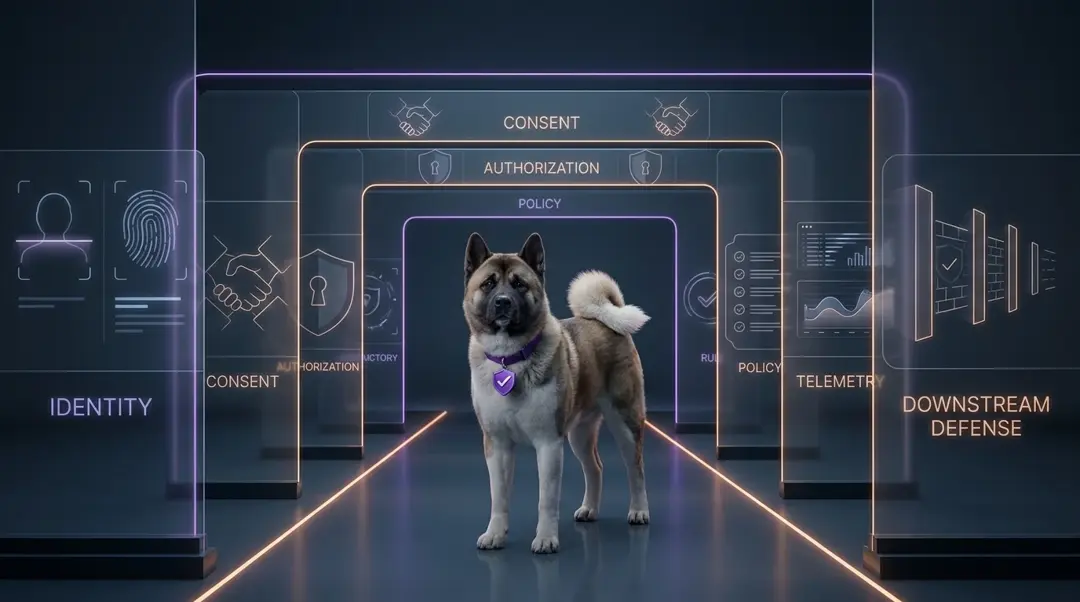
An MCP gateway is not just a safer proxy. In production, it becomes the control layer between a human, an agent, the tools that agent can invoke, and the applications or data those tools reach. That means a real MCP gateway must enforce identity, consent, authorization, policy, telemetry, and downstream controls — not just route traffic.
Most teams start by treating MCP as a transport problem. That is understandable, but incomplete. Once agents are allowed to discover tools, inherit access, and execute actions on behalf of people, the gateway stops being simple middleware and becomes part of the identity, authorization, and audit stack.
That is why strong MCP gateways are not thin middleware. They are the place where human identity, agent identity, consent, policy, telemetry, and downstream enforcement all meet. If one of those layers is missing, the system may still work in a demo, but it becomes very hard to govern in production.
After repeated conversations with banks, insurers, healthcare teams, and platform groups, the pattern is surprisingly consistent. The teams that move fastest are the ones that stop asking whether they need “an MCP proxy” and start asking whether they can enforce six distinct control layers across the whole path from human to agent to tool to application data.
| Layer | What it guards | What breaks without it |
|---|---|---|
| Human ↔ agent identity binding | Ensures each agent action can be traced to a real delegated identity | Agents become orphaned or over-trusted |
| Consent and delegation capture | Records why access was granted, for which tools, and for how long | Reviewers cannot prove authorization or revoke confidently |
| Tool-level authorization and trust tiers | Applies least privilege to each MCP tool call | One broad grant expands into unnecessary risk |
| Policy decision and context distribution | Keeps runtime decisions aligned with live policy and live context | Drift appears between UI, code, and enforcement points |
| Audit, telemetry, and guardian hooks | Creates a usable incident trail and response surface | Teams can see failures only after damage is done |
| Downstream defense in depth | Carries the decision beyond the gateway into APIs, services, and data | The gateway says “deny” but the data layer never hears it |

The layers are cumulative: each one closes a different governance gap, and the stack only becomes durable when all six work together.
The first question every serious reviewer asks is simple: who is this agent acting for? If the answer is just “the IDE connected successfully,” the system is not ready. In production, the gateway has to bind an agent session to a verified human identity, and it has to do that in a way that survives audits, revocations, and incident response.
This matters because agent sessions are delegated sessions. The agent is not acting on its own authority in the way a static service account might. It is inheriting authority from a human, often temporarily, and often for a very specific task. If that chain of identity is weak, everything that follows becomes harder to defend.
Permit treats this as a first-class control. Humans authenticate through the organization’s existing identity stack, open a consent session, and create an agent-scoped session that can be tied back to both the human and the client environment. That means revocation, expiration, and investigation can happen against the actual delegated session, not a vague shared credential floating between tools.
The next layer is not authentication but explanation. Security teams, auditors, and privacy reviewers all end up asking the same thing in different language: who said this agent could do that? A system that cannot answer that question clearly will eventually become a compliance problem even if the runtime controls are technically strong.
Consent capture is what makes the delegated relationship explicit. It should record which tools were approved, what level of access was granted, how long the grant should live, and why the agent was allowed to act in the first place. In some environments that “why” is a ticket, an internal request, or a specific workflow. In others it is an approval event tied to a business process.
This is where MCP governance starts to feel less like infrastructure and more like operational discipline. Teams that capture consent up front are much faster when a review comes in later, because they can show not only that a tool call happened, but that it was authorized intentionally and within a defined scope.
A common mistake in early MCP deployments is treating tool access as a single decision. Once the agent can “use Salesforce” or “use Jira,” the system behaves as though the rest will work itself out. In practice, that is too coarse. A read-only search flow, a record update, and a destructive administrative action should not sit in the same trust bucket.
That is why MCP gateways need tool-level authorization rather than broad platform access. Each tool call should be evaluated in context, with policy deciding whether this human-agent pair may perform this action, against this tool, under this trust level, right now. This is the operational meaning of least privilege in an agent system.
Trust tiers help make this understandable. A team may choose to allow low-risk retrieval actions automatically, require stronger policy for transactional updates, and escalate destructive operations to a guardian workflow or approval gate. The point is not to make the agent unusable. The point is to stop treating every tool path as equally safe.
Policy is only useful if the decision engine sees the right context at the right moment. That sounds obvious, but it is where many systems drift. The UI shows one thing, the gateway enforces another, and the downstream application still carries yesterday’s assumptions. By the time something breaks, no one is sure which layer actually made the decision.
A production MCP gateway needs a policy model that can be evaluated close to the workload and updated with live context. That usually means a combination of policy-as-code, a distribution layer, and a runtime decision point that understands identities, consent, tool metadata, and any additional attributes the organization uses to decide access.
In Permit’s model, this is where OPA, Cedar, OPAL, and the Permit PDP become operational rather than theoretical. The goal is not just to centralize policy, but to prevent policy drift between the gateway, the application layer, and any other enforcement points that care about the same delegated action.
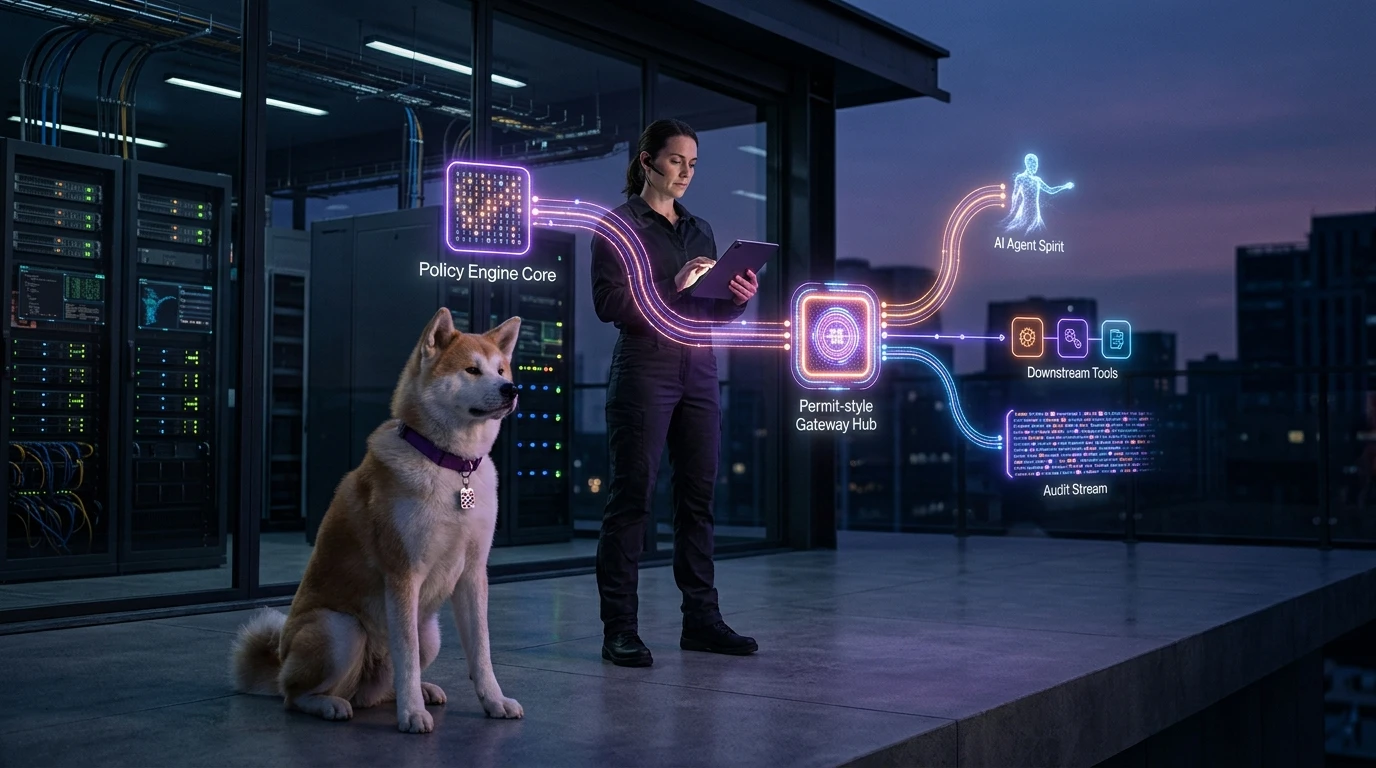
At runtime, the gateway becomes the control plane between delegated identity, policy evaluation, downstream execution, and the evidence trail security teams depend on later.
Even a well-governed system will eventually hit strange behavior. An agent may start making repeated denials, spike its use of a tool, or try an action outside the normal trust pattern for that workflow. When that happens, the question is not only whether the gateway can block the call. The question is whether the team can understand what happened quickly enough to respond.
That is why audit and telemetry are their own layer rather than a side effect. A usable MCP gateway should produce a decision trail that security teams can actually work with. That trail should connect the human identity, the agent session, the consent record, the tool invocation, the policy result, and enough context to explain why the system allowed or denied the action.
Guardian hooks make this even more practical. Once the event stream is structured well, automated responders can pause an agent session, revoke a consent bundle, notify Slack or PagerDuty, or attach richer evidence for incident review. That turns the gateway from a passive checkpoint into an active control surface.
The final layer is the one teams most often postpone until later: carrying the decision beyond the gateway. But the gateway alone cannot solve the full problem. If an agent call is approved at the edge and then enters an application, API, or database layer that has no understanding of the delegated identity, the system loses most of the value of the original control.
This is why downstream defense in depth matters. The identity and policy context established at the MCP layer should be replayed into the rest of the stack where appropriate. That may mean evaluating related policies in APIs, application services, or data access layers. It may also mean using the same distributed policy model so the gateway and downstream components agree on the world they are enforcing.
Without that, the gateway becomes a ceremonial checkpoint. With it, the gateway becomes the front door to a coherent authorization system.
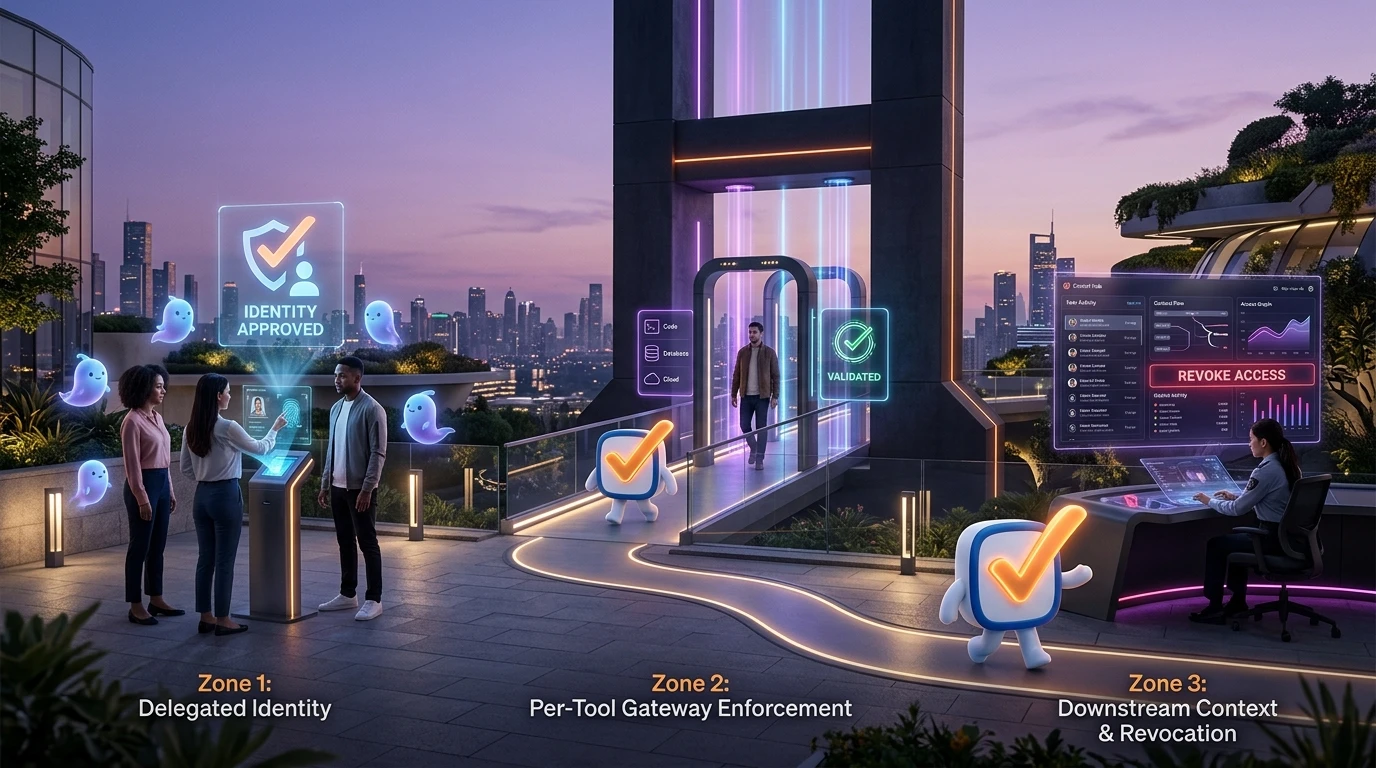
The practical sequence is straightforward: establish a delegated session, enforce per-tool decisions at the gateway, then replay the same context and revocation model into the rest of the stack.
The six layers matter because they answer different failure modes. Identity binding prevents orphaned agency. Consent capture prevents silent overreach. Tool-level authorization limits blast radius. Policy distribution prevents drift. Audit and guardian hooks make response possible. Downstream replay keeps the rest of the stack aligned with the edge decision.
Teams do not need to implement all of that in the most complex possible form on day one. But they do need to recognize that these are separate responsibilities. Production MCP security breaks when an organization compresses all of them into “we added a proxy.”
That is the practical takeaway. A real MCP gateway is not just there to connect agents to tools. It is there to make those connections governable. If you can explain how your stack enforces these six layers, you are much closer to something a security team can approve.
An MCP gateway is the policy and routing layer between AI agents and the tools they invoke. In mature deployments, it becomes part of the trust boundary because it decides which human-approved agent actions can reach which downstream tools and systems.
A proxy moves traffic. A production MCP gateway also enforces delegated identity, consent scope, tool-level authorization, policy decisions, audit trails, and downstream context propagation. If it only forwards requests, it cannot meaningfully govern agent behavior.
The six layers are human-to-agent identity binding, consent and delegation capture, tool-level authorization and trust tiers, policy decision and context distribution, audit and guardian hooks, and downstream defense in depth. Together they answer who is acting, why access was granted, what is allowed now, how that decision is enforced, and how the organization investigates or revokes it later.
Usually the system still works technically, but governance breaks. Missing identity creates orphaned agent actions. Missing consent weakens review and revocation. Missing tool-level policy expands blast radius. Missing telemetry slows incident response. Missing downstream enforcement turns the gateway into a checkpoint the rest of the stack can ignore.

Co-Founder / CEO at Permit.io