



Loading
3366 Members
 Join Permit's Slack
AI agents don’t just log in and view a page. They chain tools, call APIs, delegate to sub-agents, and keep acting after the first prompt.
The authorization question is now operational, continuous, and high-stakes: is this agent allowed to take this exact action, for this human, on this resource, through this tool, right now?
If your stack cannot answer that in real time, you do not have production-ready AI agent authorization.

RBAC is not wrong. RBAC is incomplete for agentic systems.
If you want background first, read RBAC vs ReBAC.
Classic SaaS authorization mostly asks: “Can this signed-in user open this page?”
Agent systems ask many more questions per workflow:
That is why OAuth and authentication are necessary but insufficient. OAuth proves identity and grants token scope. It does not, by itself, solve contextual AI agent access control at every tool call.
And this matters now because MCP adoption is accelerating. Direct model-to-MCP-server connections are convenient, but without centralized policy enforcement they can bypass organizational controls.
In agentic systems, the principal is not just “user” or “service account.” The real principal is a delegated execution identity:
(human delegator) → (agent identity) → (tool action) → (resource) under tenant + policy context
Every authorization decision should evaluate at least:
This is the core of delegated authorization for AI agents.

Delegated identity is the core security object in agentic systems: who delegated, which agent acts, what tool is invoked, and which tenant resource is touched.
RBAC remains the fastest way to set broad boundaries, and the NIST RBAC model is still foundational for separation of duties.
Use RBAC to answer questions like:
In our running example, RBAC sets baseline roles:
support_rep can initiate refund review flows.refund_review_agent can call read/check endpoints.billing_approver can finalize refunds.That is necessary. It is not sufficient.
Now the same refund flow gets real:
acme-eu asks the support agent to review refund for customer cust_447.RBAC alone cannot cleanly decide:
cust_447 in Dana’s allowed workspace?This is where teams bolt on custom code and drift into inconsistent enforcement.
ReBAC models who can do what through relationships and derived permissions:
dana member_of workspace:acme-eu-supportagent:refund-review acts_for danaaccount:cust_447 belongs_to tenant:acme-eutool:billing.refund.create allowed_for agent:refund-review only under delegator scopeThat graph aligns with how agents actually operate: delegated, resource-specific, tenant-aware, and dynamic.
Add ABAC/PBAC-style conditions (amount thresholds, risk score, time windows), and you get fine-grained authorization for AI agents without hardcoding business logic in every service.
End-to-end decision for one tool call:
refund-review-agent.billing.refund.create for account:cust_447 in tenant:acme-eu.<= $250) and runtime constraintsThat is practical MCP authorization and delegated enforcement, not just role lookup.
| Decision question | RBAC | ReBAC | Recommended Permit pattern |
|---|---|---|---|
| Delegation (human → agent) | Manual conventions | Native relationship modeling | Model acts_for / delegated edges + policy checks in PDP |
| Sub-agent propagation | Hard to enforce consistently | Relationship chain can propagate scope | Carry delegator + parent-agent context via MCP Gateway and evaluate per hop |
| Tenant isolation | Role naming by tenant (explodes) | Tenant-resource relationships are explicit | Tenant-scoped resources + relationship tuples + policy conditions |
| Tool-level enforcement | Usually coarse, service-level | Can be per-tool and per-resource | Enforce every MCP/API action through gateway + PDP |
| Resource hierarchy | Limited; custom app logic | First-class graph traversal | Use ReBAC hierarchy + derived roles |
| Audit explainability | “Role allowed it” | “Relationship + condition allowed it” | Permit audit logs with subject/action/resource/context trail |
| Operational complexity | Low at start, high at scale | Moderate modeling effort, better scale behavior | Start RBAC baseline, add ReBAC for high-risk workflows |
| Best first use case | Simple internal agents | Delegated, customer-facing agents | Hybrid: RBAC guardrails + ReBAC precision |
| Failure mode | Over-permissioning / role explosion | Missing relationship data quality | Policy + data validation + audit-driven tuning |
| Permit implementation pattern | RBAC policy in control plane | ReBAC tuples + conditions | Unified policy model in Permit, enforced by PDP near runtime |
Use three layers together:

Production-ready agent authorization layers RBAC boundaries, ReBAC delegation/resource checks, and conditional policy controls together.
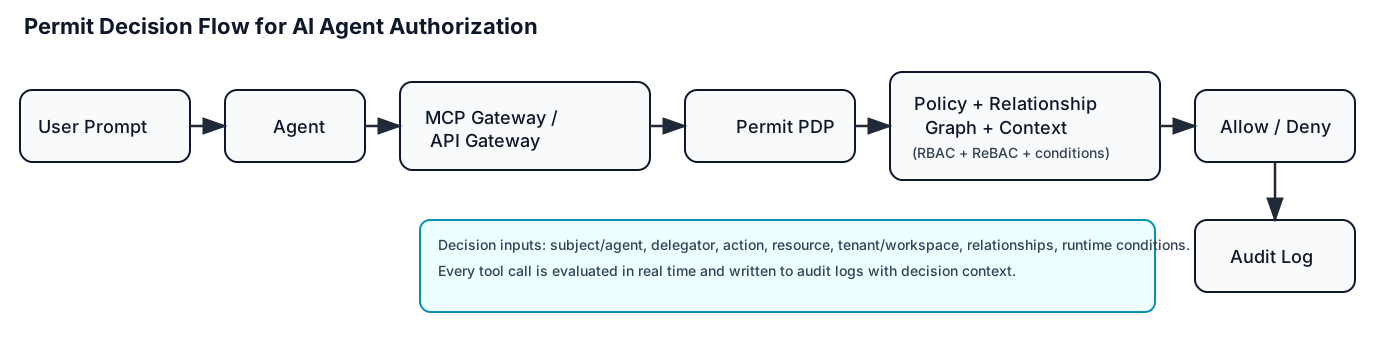
Decision inputs to evaluate on every call: subject/agent, delegator, action, resource, tenant, relationships, and conditions.
# RBAC-only (coarse)
allow {
  input.subject.role == "refund_review_agent"
  input.action == "billing.refund.create"
}

# Delegated + relationship-aware + conditions
allow {
  input.action == "billing.refund.create"

  # RBAC boundary
  input.subject.role == "refund_review_agent"

  # ReBAC delegation + tenant/resource relationship
  relation_exists(input.subject.id, "acts_for", input.delegator.id)
  relation_exists(input.delegator.id, "member_of", input.tenant.id)
  relation_exists(input.resource.id, "belongs_to", input.tenant.id)

  # Runtime condition (ABAC/PBAC)
  input.context.refund_amount <= input.delegation.max_refund_amount
  input.context.risk_score < 0.7
}
Permit gives you a practical control plane + data plane model for AI agent permissions and delegated authorization:
Secure your first MCP server with Permit MCP Gateway. Start here: https://docs.permit.io/permit-mcp-gateway
Model RBAC + ReBAC in Permit. Start with policy basics and ReBAC docs.
No. RBAC is still the right baseline for broad boundaries and governance. It just cannot carry delegated, per-resource, runtime decisions alone.
Usually yes. OAuth scopes answer what a token may attempt. ReBAC helps answer whether this delegated agent may perform this action on this specific resource in this tenant now.
At a centralized enforcement layer (for example MCP/API gateway + PDP), not only inside individual MCP servers.
RBAC guardrails + ReBAC relationship checks + runtime conditions + per-decision audit logs.
For modern AI agent authorization, the serious pattern is clear: use RBAC to define boundaries, ReBAC to enforce delegated/resource-aware decisions, and conditions to control runtime risk.
Anything less will either over-permit agents or block useful automation.
Want to see how this works for your agents? Try Permit MCP Gateway or book a technical walkthrough.

Co-Founder / CEO at Permit.io