Quick answer: From 10 December 2026, APP 1.7 requires certain Australian APP entities to disclose in their privacy policy the kinds of personal information and decisions involved when computer programs make, or substantially assist, decisions that significantly affect individuals. Use this post to prepare engineering evidence. Don't treat it as legal advice or a policy template: privacy counsel decides your wording and scope.
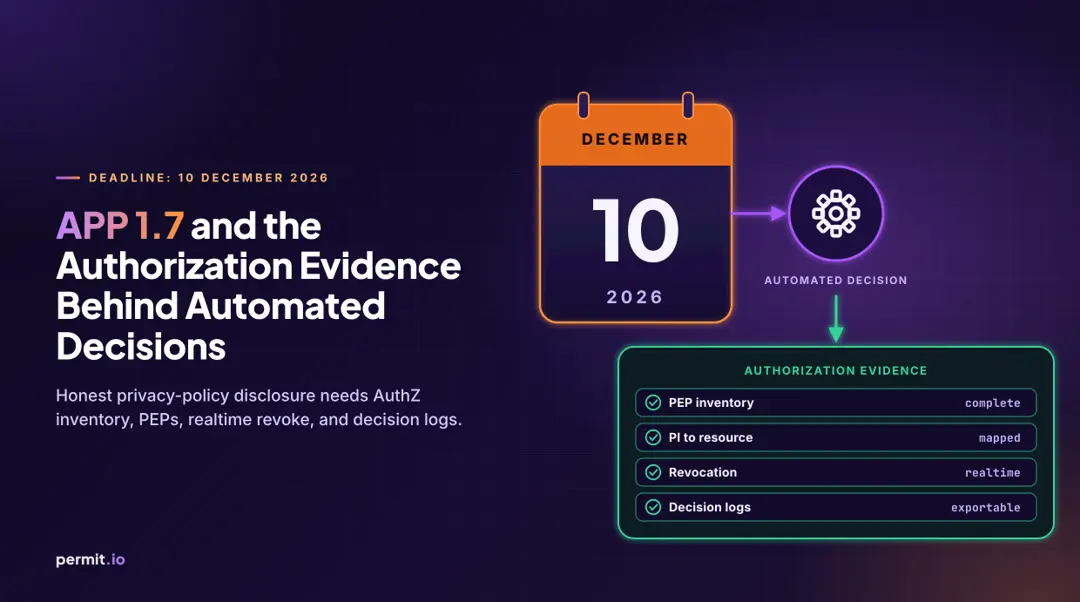
From 10 December 2026, APP 1.7 creates a hard privacy-policy obligation for APP entities that arrange for computer programs to make, or substantially and directly assist, decisions that could significantly affect an individual's rights or interests, where personal information about that individual is used in the program's operation. The policy wording belongs with privacy counsel. But truthful disclosure depends on engineering evidence: an inventory of decisioning systems and agents, provenance for the personal information they use, and authorization logs that show who or what could access which data, under which policy, for which decision path. AuthZ is not legal drafting. It is the control layer that makes the drafting defensible.
What APP 1.7-1.9 actually require
The Privacy and Other Legislation Amendment Act 2024 introduced APPs 1.7, 1.8, and 1.9. They commence on 10 December 2026.
From that date, an APP entity must include additional information in its APP Privacy Policy if all of the following are true:
- the entity arranges for a computer program to make a decision, or to do a thing substantially and directly related to making a decision;
- the decision could reasonably be expected to significantly affect the rights or interests of an individual; and
- personal information about the individual is used in the operation of the computer program.
The text of APP 1.7, as reproduced by the Office of the Australian Information Commissioner (OAIC), reads:
1.7 Without limiting subclause 1.3, the APP privacy policy of an APP entity must contain the information covered by subclause 1.8 if: (a) the entity has arranged for a computer program to make, or do a thing that is substantially and directly related to making, a decision; and (b) the decision could reasonably be expected to significantly affect the rights or interests of an individual; and (c) personal information about the individual is used in the operation of the computer program to make the decision or do the thing that is substantially and directly related to making the decision.
Source: OAIC, Automated Decision-Making Transparency Obligation (APP 1), Attachment A: text of Australian Privacy Principle 1.7
APP 1.8 sets the disclosure categories: the policy must describe the kinds of personal information used in the operation of such computer programs; the kinds of such decisions made solely by the operation of such computer programs; and the kinds of such decisions for which a thing substantially and directly related to making the decision is done by the operation of such computer programs.
APP 1.9 clarifies two important points. "Making a decision" includes refusing or failing to make a decision. And the obligation applies whether the decision is beneficial or adverse to the individual.
The OAIC has given examples of decisions that may affect rights or interests, including decisions under legislation to grant or refuse a benefit, decisions affecting rights under a contract or agreement, and decisions affecting access to a significant service or support, such as healthcare.
This is a transparency and privacy-policy obligation. It is not, by itself, a general right to human review. It is not a ban on AI. It is also not limited to AI; the language is broader than that. Rules engines, scoring systems, workflow automation, and agentic systems can all become relevant depending on the decision and the personal information used.
The amendments apply to decisions made from 10 December 2026, regardless of when the arrangement was made, the program was created, or the personal information was collected. Existing systems can therefore matter from commencement.
The OAIC has said it will publish detailed guidance about these APP 1 obligations in 2026, and that guidance may evolve. That is another reason to build an evidence base now rather than treat this as a last-minute policy rewrite.
The AuthZ homework list
The practical question for security and engineering leaders is simple: can you prove what personal information your automated decisioning systems and agents are allowed to use, and under what conditions?
Here is the tighter homework list.
1. Inventory decisioning programs, agents, and workflows
Build a living inventory of computer programs that may make, refuse, fail to make, recommend, route, escalate, or substantially assist a decision that could significantly affect an individual.
Do not stop at "AI models." Include rules engines, eligibility services, fraud workflows, scoring systems, triage tools, orchestration layers, and agents that call tools or retrieve information for a decision path.
For each item, capture owner, decision function, sole vs assisted path, kinds of personal information used, systems/tools involved, and current enforcement/logging posture. That inventory bridges privacy language and production reality.
2. Map personal information to resources and actions
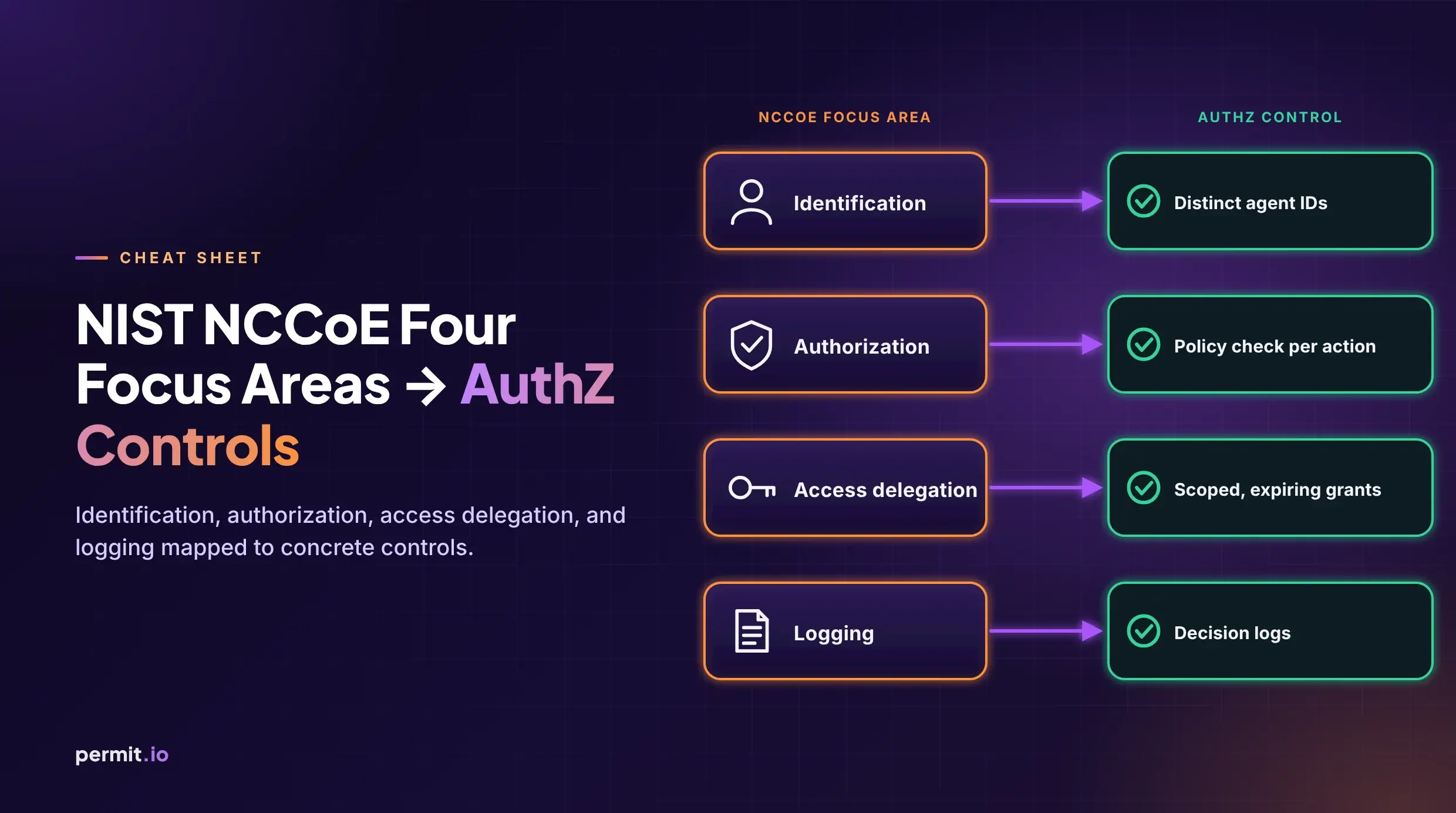
APP 1.8 asks for "kinds" of personal information and "kinds" of decisions. Engineering teams should map those kinds to concrete authorization objects.
Map kinds of PI to concrete resources and actions (for example profile.read, transactions.read, eligibility.calculate, service_access.approve / service_access.refuse), then attach tenant, product, purpose, workflow step, and human or agent identity. Broad internal grants like "the risk service can read customer data" are too vague for consequential decisioning disclosure.
3. Put PEPs at data-access and decision points
Authorization evidence only matters if enforcement happens at the right boundary.
For automated decisioning, there are two critical enforcement points:
- Data-access PEPs before a user, service, workflow, or agent reads personal information.
- Decision-action PEPs before a system approves, refuses, routes, escalates, recommends, or overrides.
As covered in PEP/PDP architecture and decision logs, the policy enforcement point asks the authorization question at runtime, and the policy decision point evaluates it against policy and context.
For APP 1.7 readiness, the decision record should show more than allow or deny. It should preserve the identity, resource, action, policy, context, tenant, time, and result. If personal information is used in a significant decision path, access to that information should not be an invisible internal implementation detail.
4. Define granular policy for ADM-related access
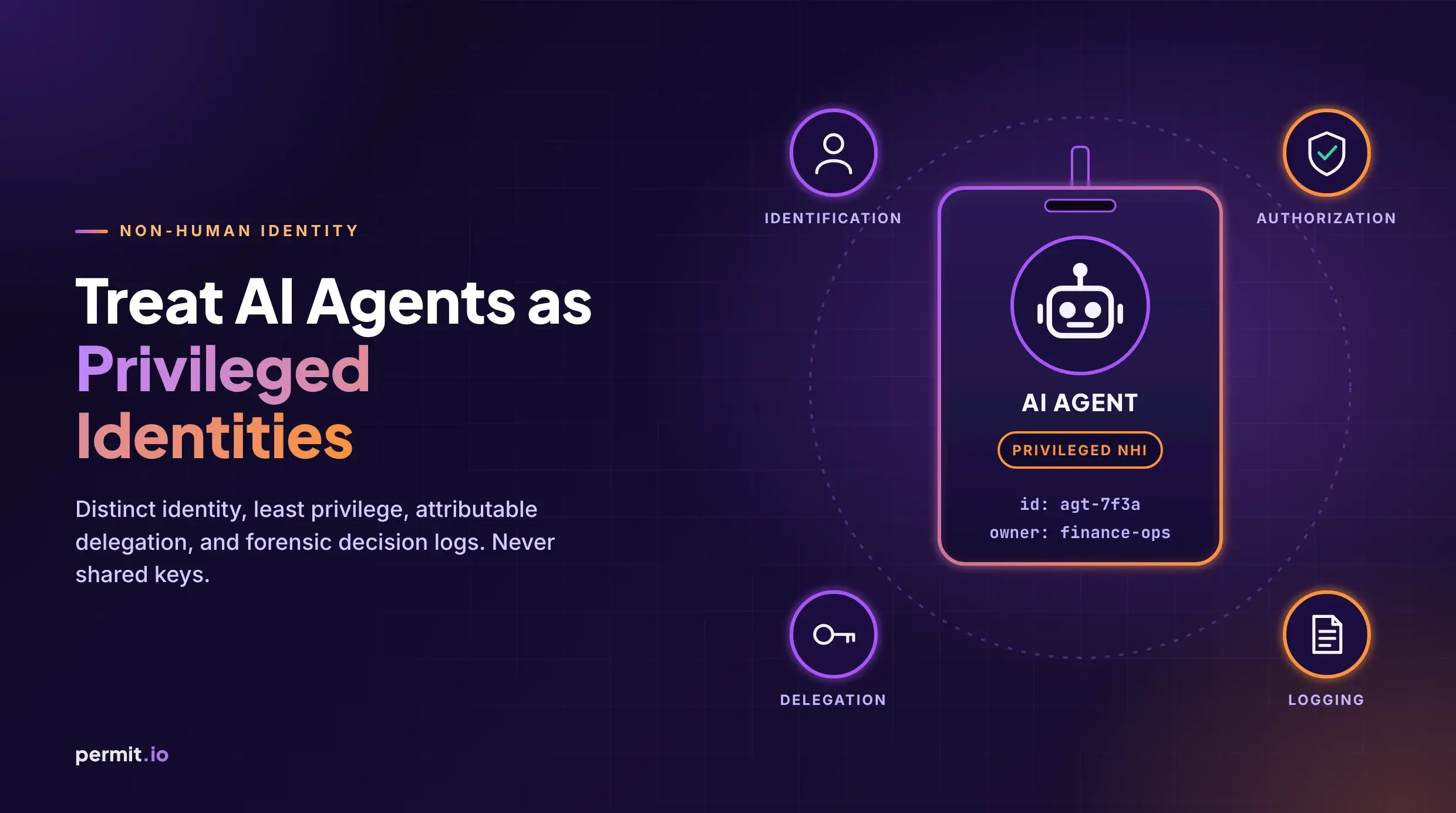
A useful policy model answers: can this agent read this PI for this tenant? Can this workflow use data for triage but not refusal? Can this model recommend review but not decide? Can a support user override? Can a batch job use historical data for monitoring but not live eligibility? The pattern is granularity across human and non-human identity, resource, action, tenant, purpose, and workflow step. As discussed in Agents as privileged identities, agents that retrieve PI, call tools, or prepare decision outputs should be governed like privileged identities, often more strictly than humans, because they act continuously and at machine speed.
5. Keep policy and authorization data synchronized
APP 1.7 does not require "realtime authorization" as a phrase. But stale authorization is how disclosure drifts away from production.
Drift happens when an agent gets a new tool, a workflow adds a data source, a model is routed through a different provider, tenant settings change, role mappings move, or emergency restrictions are applied during an incident.
If authorization changes propagate slowly while automated workflows change quickly, your evidence describes yesterday's system. Realtime sync and revoke help keep the enforcement layer aligned with the actual decisioning path.
6. Export audit evidence that supports disclosure
The goal is not to paste raw logs into a privacy policy. The goal is to support the policy statement with operational facts.
Useful evidence covers systems and agents in the decision path, PI categories accessed, human and non-human identities, policy versions, allow/deny decisions by resource/action/tenant/time, and permission-change history. That lets privacy and legal describe kinds of PI and kinds of decisions from production facts, not only interviews.
The APRA parallel: overlapping pressure, not the same rule
For APRA-regulated entities, APP 1.7 sits alongside a broader prudential conversation about AI and operational resilience.
APRA's April 2026 Letter to Industry on Artificial Intelligence did not announce a separate dedicated AI prudential standard in that letter. It did state that the existing prudential framework applies, and it signalled expectations for a step-change in governance, risk management, assurance, and operational resilience.
Authorization themes in that letter are familiar: IAM that may not yet account for AI agents and other non-human actors; stronger controls for agentic workflows; privileged access beyond admins to tools, models, and service identities; human involvement for high-risk decisions; inventories of AI tooling and use cases; and assurance that lags deployment. That is parallel pressure, not a claim that APP 1.7 is an APRA requirement. Permit.io does not satisfy APRA obligations or replace CPS 230, CPS 234, or any other prudential standard, but the same muscles show up: inventory, NHI IAM, enforcement, privileged access, realtime change control, and evidence.
The crosswalk: muscles you already built
APP 1.7 readiness should not feel like a new control universe. It is another reason to build access control you can prove.
The Week 8 support companion, the four-pillars APP 1.7 checklist, turns this into a more tactical review path.
Where Permit fits
Permit.io is an authorization platform. The right way to think about Permit here is product second, homework first: define the systems, data, actions, and evidence you need; then use an authorization architecture that can enforce and observe them.
Permit uses a hybrid PDP model. Policy management and configuration live in the control plane, while authorization decisions can be evaluated close to your application in the data plane. For regulated and privacy-sensitive systems, that matters because you can enforce policy near the protected resource without making every access check dependent on a remote SaaS call. See how Permit works and the PDP documentation.
OPAL is the realtime policy and data distribution layer behind this model. It helps synchronize policy and authorization data to PDPs, so changes in permissions, relationships, tenant configuration, or policy can take effect quickly. See Permit's control plane / data plane split and how Permit works.
For APP 1.7-style readiness, the pattern is:
- model ADM-related resources and actions;
- enforce through PEPs at application, API, workflow, and agent-tool boundaries;
- evaluate with PDPs close to the service;
- sync policy and authorization data in near real time;
- retain audit logs for authorization decisions and policy activity.
Permit's audit log types and filtering cover the product concept. Those logs do not write the APP Privacy Policy. They help answer the operational question behind it: what did our users, services, and agents have permission to access, and what did the authorization layer decide?
The 90 / 60 / 30-day countdown
Count back from 10 December 2026. If your environment is complex, start earlier. But these windows are useful forcing functions.
90 days before: baseline the evidence
- Inventory decisioning programs, agents, workflows, rules engines, and models.
- Capture kinds of PI used and kinds of decisions made or supported.
- Map owners across privacy, legal, security, engineering, and product.
- Identify non-human actors and existing PEPs, logs, and blind spots.
- Produce a gap list: missing enforcement, missing logs, unclear provenance, unowned agents.
60 days before: close control gaps
- Harden PEPs at PI-access and decision-action points.
- Separate human, service, and agent permissions; least-privilege agents and tools.
- Add tenant/purpose/workflow context where supported; validate realtime sync and revoke.
- Confirm decision logs have usable context; test denied paths, not only allowed ones.
- Review model-provider and tool-calling paths for PI exposure.
Authentication is not enough. IAM may identify the caller; authorization decides whether that caller, in this context, can access this PI or perform this decision action.
30 days before: reconcile policy language with production
- Reconcile APP Privacy Policy wording with the inventory and evidence.
- Confirm disclosed kinds of PI and kinds of decisions, including sole vs assisted, refusal/failure, beneficial and adverse.
- Confirm log retention/export; tabletop complaint, incident, and agent-permission scenarios.
- Govern late changes to ADM-related access paths tightly; get legal sign-off on applicability and wording.
The point is not to turn engineers into lawyers. It is to prevent legal from drafting in the dark.
The operating principle
Can you accurately describe the personal information your automated systems use, the kinds of significant decisions they make or support, and the controls governing access to that information? SaaS vendors selling into Australia will hear the same question in customer reviews. For APP entities and APRA-regulated organizations, privacy transparency, AI governance, privileged access, and operational resilience converge on one control surface: who or what can access sensitive data, under what conditions, to make or assist which decision.
This is not legal advice, and Permit does not guarantee compliance with the Privacy Act, APRA expectations, SOC 2, DORA, or any other framework; counsel should confirm applicability and wording.
Start with the inventory. Map PI to resources and actions. Put PEPs at the right boundaries. Treat agents as privileged identities. Keep policy synchronized. Preserve audit evidence. Then let counsel translate production facts into the APP Privacy Policy.
For the tactical version, use the companion four-pillars APP 1.7 checklist. To see how Permit's hybrid PDP, OPAL-based realtime sync, and audit logs can support the authorization evidence layer, talk to us.