

Loading
3366 Members
 Join Permit's Slack
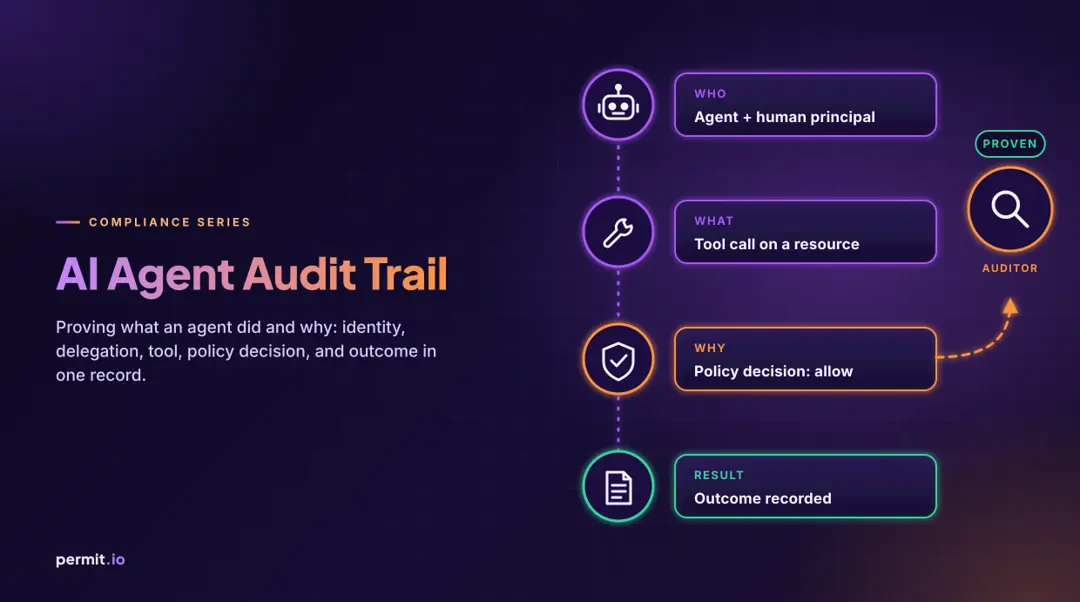
An AI agent audit trail proves what an agent did and why. You build it with authorization decision records that bind agent identity, the human principal or delegation chain, tool and resource, policy version, allow/deny with reason, any HITL approval, timestamps and correlation IDs, and preferably the outcome of the side effect. Tool traces alone are not enough.
An LLM trace can tell you what the model said. A tool trace can tell you what function was called. An authorization record tells you whether that action was permitted under the policy in force at that moment, for that agent, acting for that user, against that resource. That is the evidence auditors care about. For the general authorization-log product pattern, see also audit logs.
Tool traces are usually operational telemetry, not control evidence. A framework may log the prompt, model response, selected tool, arguments, latency, tokens, and errors. Useful for debugging. Not enough to prove access control.
For audit, the questions are: Who or what was authorized? On whose behalf? Under which policy? Against which resource? Allow or deny, and why? Was approval required? Was the side effect completed? Can we reproduce the decision later?
Telemetry explains model behavior. AuthZ evidence explains control enforcement. For more on that distinction, see Why Was This Allowed?.
Auditors sample evidence around access, change, monitoring, and incident response. For AI agents they ask the same control questions they already ask for humans and services, with a new actor type.
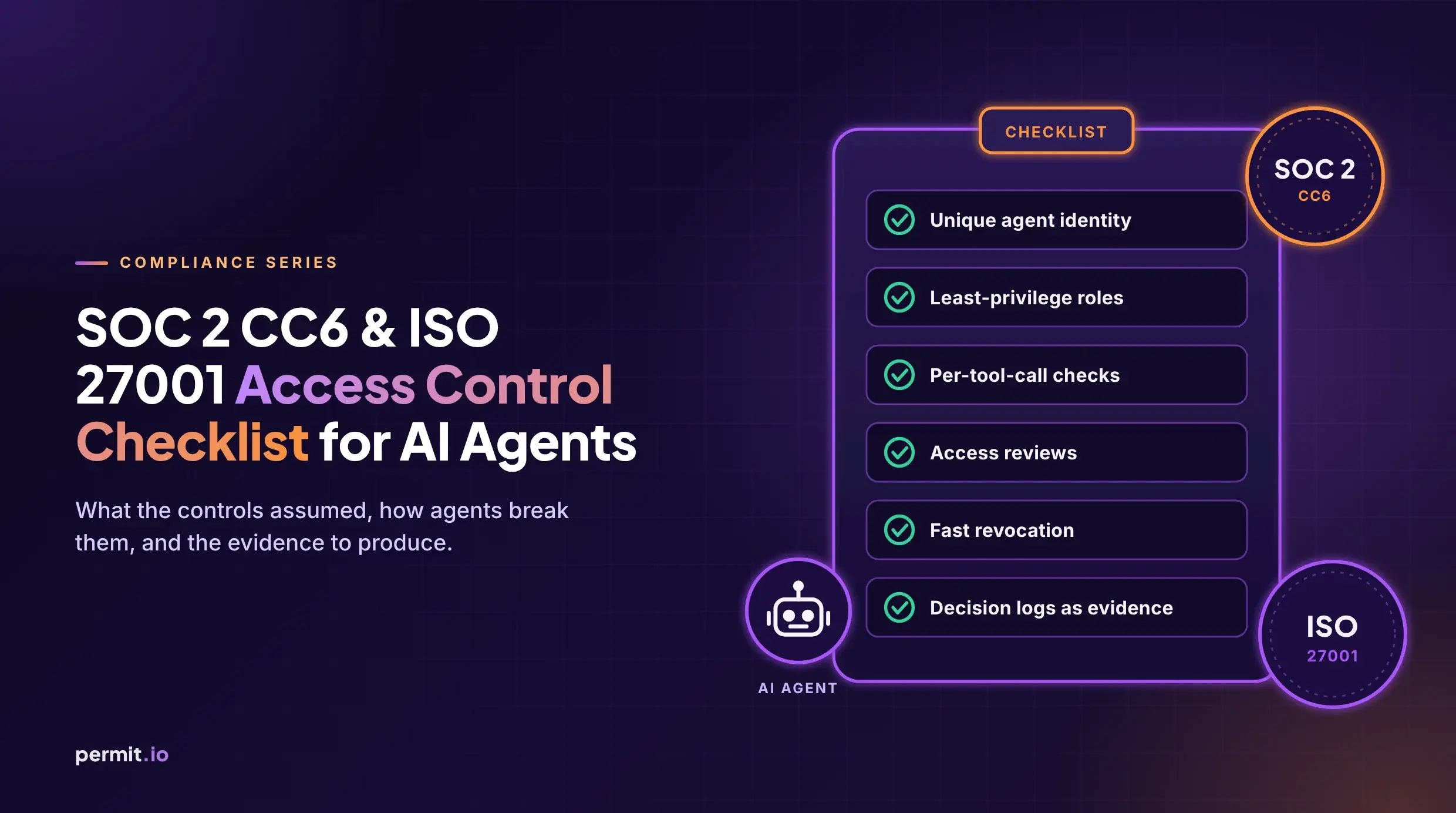
For SOC 2, that usually maps to logical access and system operations conversations around CC6 and CC7 in the AICPA Trust Services Criteria. For ISO 27001, expect similar questions around access management and logging, including Annex A.8.15. Overview: ISO/IEC 27001.
They may pick a sensitive action and ask for the initiator, any approval, the policy that allowed it, evidence that denies are also logged, how agents are kept from exceeding permissions, how logs are protected and retained, and how you investigate anomalies.
"Our agent framework logs tool calls" proves execution, not authorization. A better answer: every tool call crosses a policy decision point, and we retain an AI agent audit trail with policy version, principal, agent, resource, action, reason, approval, timestamp, and correlation IDs.
Treat each agent action as an audit envelope. Capture at least:
The exact schema can vary. The envelope should let an auditor reconstruct both the control decision and the resulting action. Explainable deny logs prove the control is active. See Explainable Deny. For the field-by-field schema, see AI Agent Audit Logs: The 12 Fields Auditors Expect.
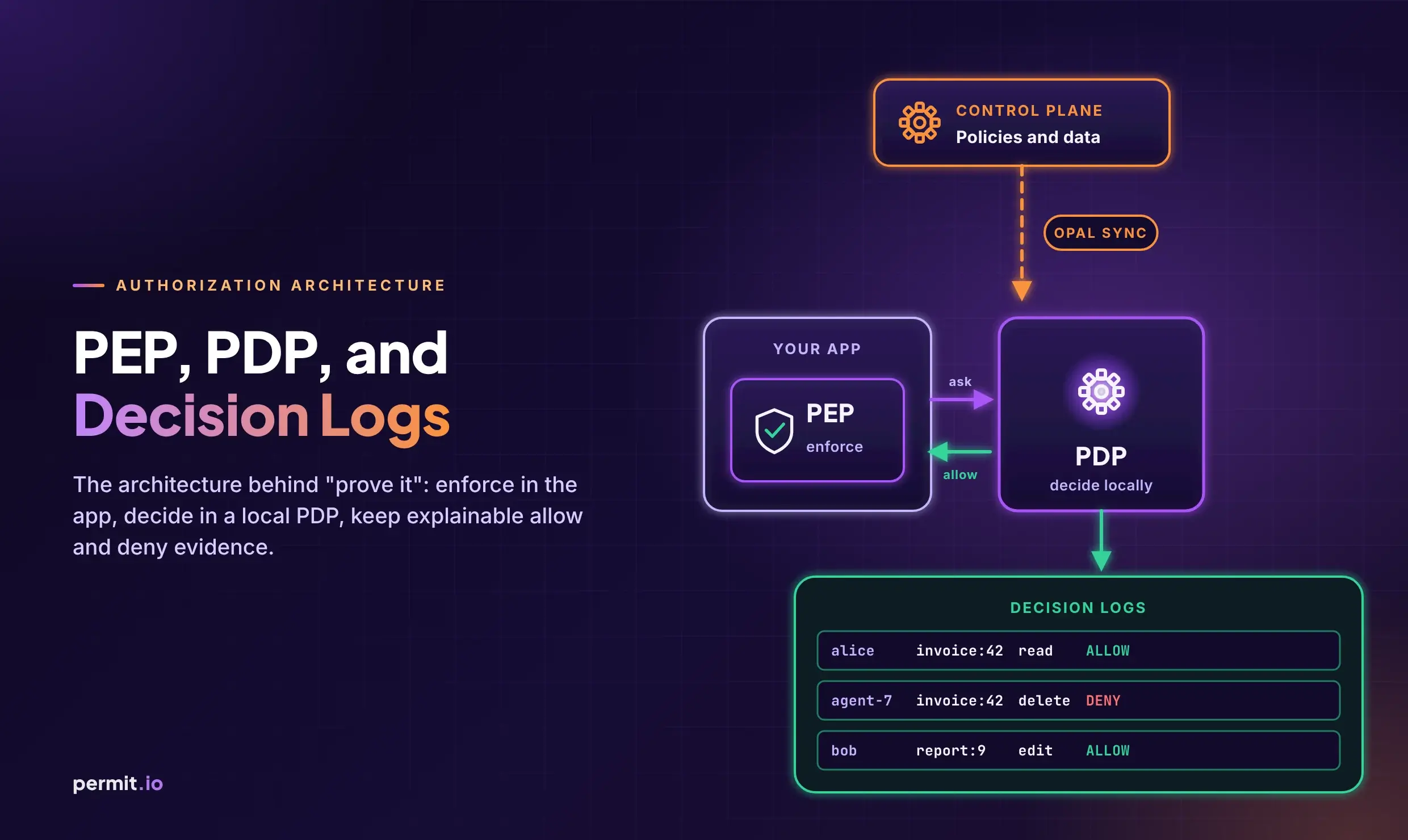
AI agent logging for authorization belongs at the authorization boundary, not inside the model. Prefer the PDP (policy decision point) or an MCP gateway that enforces authorization before a tool executes. That is the moment intent becomes a possible side effect. If you log only after the tool runs, you missed the control point.
Agents may call many tools quickly. You do not want every control to depend on best-effort application code or prompt instructions. You want a real authorization checkpoint at every sensitive tool-call boundary, with joinable correlation to the tool trace and the final system change.
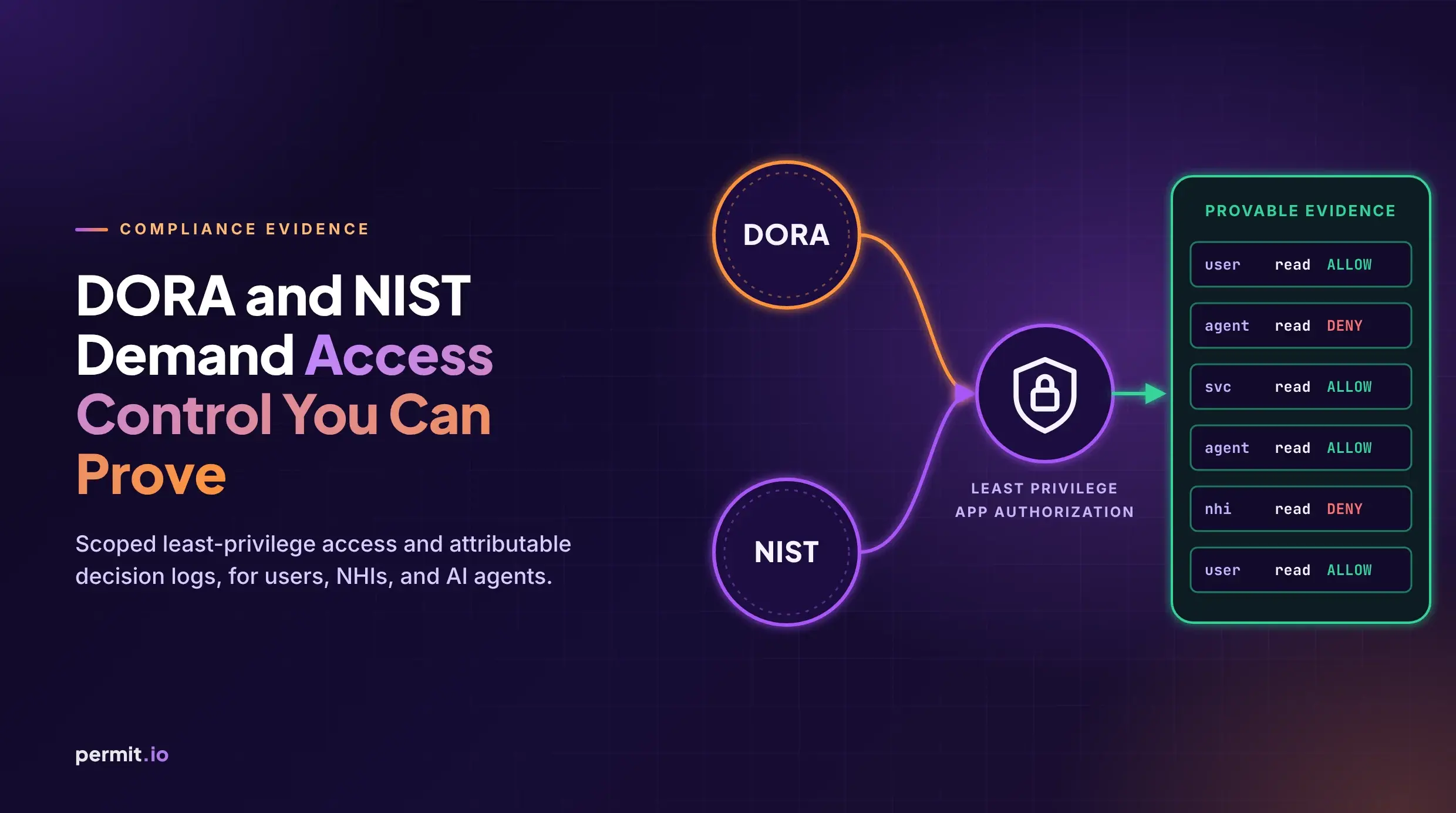
If you are moving from broad agent permissions toward scoped models, also see Authorization Models to Least-Privilege Evidence.
When a policy requires a human to approve an agent action, the approval is part of the authorization evidence, not a side conversation in Slack. Record the approval ID, who approved or rejected, when, and which request it applied to, and link it to the same trace ID as the tool call. An auditor sampling a sensitive action should see: policy said approval required, this person approved at this time, then the side effect ran. For designing the approval flows themselves, see human-in-the-loop for AI agents.
Replaying does not mean re-running the model with a new temperature. It means reconstructing the decision: same principal, agent, tool, resource, policy version, attributes, approval state, and outcome. Immutable, correlated records make that possible. Prompt text may be stored under a separate privacy and retention model; the authorization envelope is what proves control.
Start from the authorization envelope for each sensitive tool call, then join it to the tool trace and the downstream system change with a shared correlation ID. That is how you audit what happened and why it was allowed.
No. They show execution and model behavior. Auditors also need proof of the access decision: who or what was authorized, under which policy, against which resource, and whether approval was required.
They help for authentication and token issuance. They usually do not prove each downstream agent action, policy version, resource context, or allow/deny reason. IdP logs are necessary. They are not a complete AI agent audit trail.
Yes, if you retained the authorization inputs and policy version with the decision. Replay here means reconstructing the control decision, not regenerating the LLM response.
Look for a gateway that sits in front of MCP servers, evaluates policy before the tool runs, and emits audit events that include agent identity, human principal, tool, resource, decision, and correlation IDs. Logging after the fact in the agent framework is not the same as enforcement-time logging.
If your compliance and engineering teams are defining this control model now, Permit can help map agent tool calls to policy, approvals, delegated access, and audit evidence. Start with Permit for compliance teams.

Co-Founder / CEO at Permit.io