

Loading
3366 Members
 Join Permit's Slack
I run a team of Grok Bots at Permit, on real work, every day. They're great. They catch things I'd miss, and they keep work moving while I sleep. So when NewCore published research this week on two Grok Bots making background requests to their connected work apps, I read it as a happy user first and as someone who builds authorization for agents second.
Here's what NewCore reports. Over five days, two Grok Bots on NewCore employee accounts made 31 requests to Google Calendar, Gmail, Slack, GitHub and Notion while nobody was talking to them, some with the owner's laptop shut. One owner declined the bot's offers of recurring check-ins four times, and the next morning, according to NewCore, the bot sent requests to every app it had been connected to. NewCore says all 31 were reads and none reached the data. Every tool call at NewCore goes through its MCP gateway, which held each request for the owner's approval and let it expire after three minutes when nobody answered.
Later, the owner asked the bot whether it had touched any connected app that day. It said no.
NewCore says it found no software vulnerability. It says xAI support described the calls as built-in background check-ins, and that on November 12 a "Proactive messages" switch for team admins was added, on by default. xAI's own "What's new in Grok Bot" video describes the feature in general terms: the primary bot wakes on its own and looks at what you've connected to find work it can pick up. Nobody outside NewCore has published a reproduction of the 31 calls yet, so read the specifics as NewCore's findings. NewCore builds a gateway for agents, and so do we, so weigh both our takes with that in mind.
The line in the report I keep coming back to is the researcher's view that the bot wasn't lying. According to NewCore, the calls came from background turns started on the platform's servers, and those turns never showed up in the chat history the bot could see. It reported the only history it had.
An agent built this way can do the same thing on any platform. It can only tell you about what's in its context, so if an action happened in a turn it can't see, its honest answer is that nothing happened. Asking the agent is not an audit.
So the record has to live somewhere the agent doesn't control. Once it lives there, the decision should live there too.
We run our own Grok Bots through our own gateway, the Permit MCP Gateway (GA). Their tool calls to the apps we connect go through it, so the record of what they did sits outside the bots. That's the setup I'd recommend to anyone running proactive agents, with whatever gateway they pick.
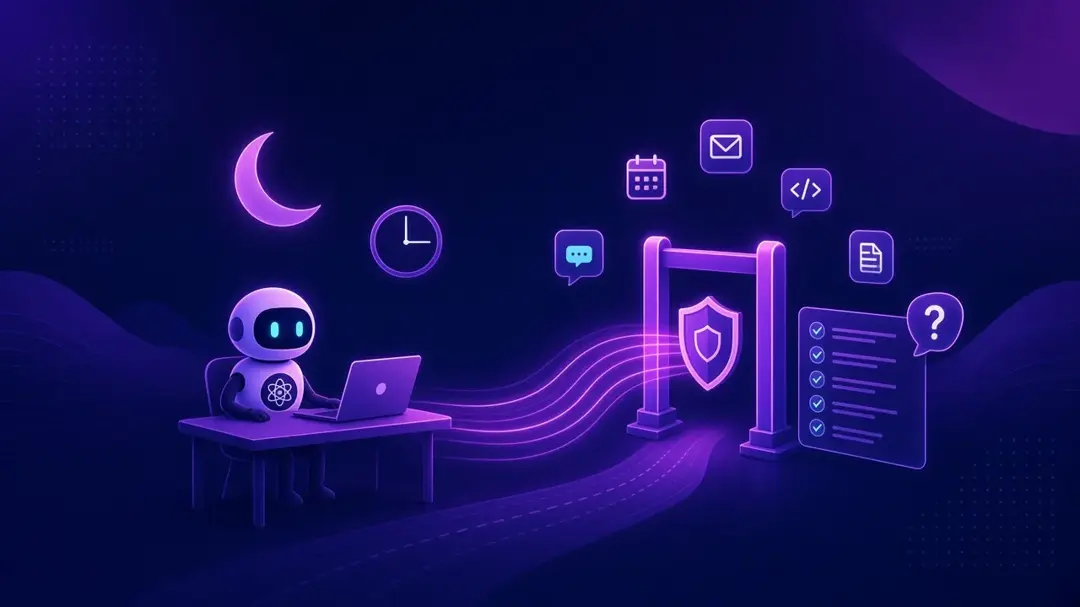
Proactive agents wake on triggers, on schedules, on "let me see what I can pick up for you." People want that. I want it. It also means an agent will use the connectors it holds at hours when nobody is watching, so "the owner didn't ask" can't be the thing that keeps it out.
The usual setup makes this harder. An agent gets an OAuth token for your mail, your calendar and your Slack, and from then on it can act as you, with every scope you granted, at any hour. That's convenient on day one and an audit blind spot by day five.
In NewCore's reported setup, the control that mattered was an enforcement point at the tool boundary that didn't rely on the agent's memory. Each call was checked, held for a person, and logged. That pattern is worth copying whoever you buy it from. Here's how we apply it, as shared in our MCP Gateway docs:
Approval answers "should this call go through right now?" A person has to be awake to answer it, and every call looks like any other read. The question I care more about is whether the agent is still doing what it was asked to do. That's where we've spent a lot of our time, and we call it agent interrogation.
As shared in our docs on Agent Interrogation, when an agent connects, the gateway exposes a single tool, identify_self, and unlocks the rest of the catalog only after the agent says who it is and what it's trying to do. The gateway combines the delegating human, the workflow context and a fingerprint taken from the agent's own answers into one identity, and uses it for policy, audit and drift detection.
That adds a layer on top of per-call approval:
Applied to a case like NewCore's, a background check-in is a session too. Under interrogation it would have to state its purpose before any connector unlocked, that statement would be logged next to what it then called, and a burst of requests to every connected app could be flagged against what it said it was doing, depending on the policy you set. I wrote more about why intent drifts after login in The Alignment Problem in AI Agents.
Interrogation has limits. It doesn't prevent prompt injection, and an agent's declaration isn't trustworthy just because it was made. What it adds is detection and enforcement at the gateway, next to your other defenses. Agent Interrogation and intent-based access control are Permit MCP Gateway Enterprise capabilities, available on request. The same idea extends past MCP: our Coding Agents Gateway, also GA, applies policy to coding agents at the endpoint.
I'm keeping them on. I'm checking which of them can act on their own, what they can reach when they do, and what they declared they were doing when they reached for it. Whether anything besides the bot would tell you what happened overnight is a question for every agent platform, including the ones I like and use, and NewCore's research is a good prompt to ask it.
Agents will keep getting more autonomous, because that's where the value is. Their access should come from a delegation a person set, checked against the intent they declared, and recorded by a layer the agent doesn't own. If the only record of what your agent did is the agent's own memory, you don't have a record yet.

Co-Founder / CEO at Permit.io