

Loading
3366 Members
 Join Permit's Slack
Quick answer: A human-to-agent delegation audit trail records who delegated authority, which agent acted, which tool and resource were involved, the policy decision with its reason, and any approval. Use it when agents act on behalf of people in systems that matter. Don't rely on prompt and tool traces alone, and skip the full envelope for read-only assistants that cannot change anything.
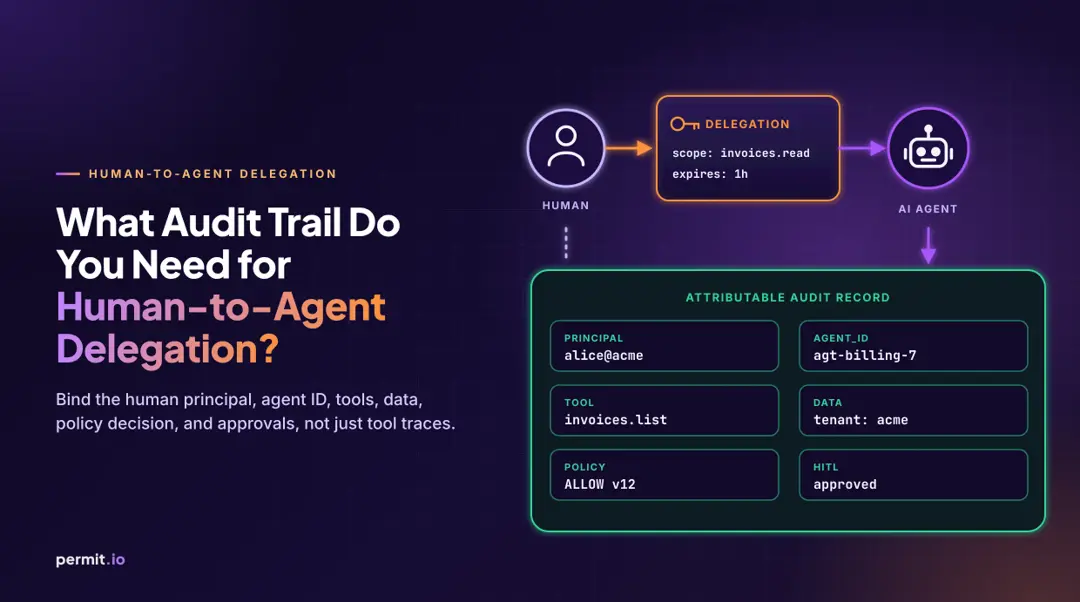
For human-to-agent delegation, you need an attributable audit trail that binds the human principal, agent ID, tools invoked, data/resources touched, the policy decision (allow/deny with reason or policy version), and HITL / consent if any. Tool traces help debug agents; they are not enough to prove authorization.
Most AI stacks already generate telemetry: prompts, completions, tool calls, latency, token usage, maybe an MCP server invocation. That is useful operational data. It tells you what happened inside the agent workflow.
It does not answer the security question:
Was this action allowed, for this agent, on behalf of this human, against this resource, at this time?
LLM/tool telemetry shows what was called. Authorization evidence shows whether it should have been allowed and under whose authority. In human-to-agent delegation, the agent operates inside a delegated boundary from a human principal, often against sensitive business systems.
If something goes wrong, "the AI did it" fails security review and incident response. Reviewers will ask which human delegated, which agent executed, which tool was invoked, which tenant or record was touched, which policy allowed or denied it, whether approval was required, and whether the chain can be reconstructed. If you cannot answer those questions, you have traces, not an audit trail.
This is an engineering evidence pattern, not a certification checklist. Capture enough context to explain delegated agent activity later.
| Evidence element | What it answers |
|---|---|
| Human principal | Who delegated, initiated, or authorized the action? |
| Agent identity / client / instance | Which agent, app, client, or runtime instance acted? Avoid collapsing all agent traffic into one generic service account. |
| Declared intent or workflow context | What task was the agent trying to perform? Capture when available; do not rely on intent alone for enforcement. |
| Tool / MCP server / action | Which tool, MCP server, connector, API, or backend action was invoked? |
| Target resource / tenant / data class | What object or scope was touched? |
| Policy decision | Allow or deny, with policy ID/version, rule, and reason where available. |
| HITL / consent | Was approval required? Who approved? Was a trust level, ceiling, or delegation boundary applied? |
| Timestamps + correlation IDs | How do you join the user request, agent run, policy decision, tool call, and downstream event? |
A useful audit trail reconstructs the chain: a human authorizes an agent → the agent attempts a tool call → policy evaluates → HITL/consent is enforced if required → allow or deny → the decision is logged with correlation. That is the difference between "we observed a tool call" and "we can prove why this action happened."
The best audit log is emitted where enforcement happens. For agentic systems, the decision must be made at the tool-call or sensitive-action boundary, the Policy Enforcement Point (PEP), not only at login.
Login proves the human authenticated. It does not prove an agent may read a specific customer record, export a file, invoke a privileged MCP tool, or trigger an operational workflow. Each action needs authorization at the point of use.
In practice, the application, API layer, or MCP gateway acts as the PEP and asks a Policy Decision Point (PDP) whether the action is allowed. For MCP, a gateway in front of MCP servers is the natural enforcement point: it can enforce per-tool policy, apply delegation and consent boundaries, and emit audit events when agents attempt to use tools.
Permit's MCP Gateway documentation covers this architecture:
The guide describes audit visibility for agent identity, tool, MCP server, and allow/deny outcome, with visibility in both app.agent.security and the Permit Audit Log. For broader filtering and decision types, see Permit audit logs: types and filtering.
The pattern is straightforward: put a PEP where the agent crosses into a real tool; evaluate policy using human, agent, tool, resource, and context; enforce allow/deny before the tool executes; emit an audit event from that decision; correlate it with your existing audit pipeline. Do not infer authorization later from a transcript.
The security bar for AI agents should be the same bar we already expect from human SaaS authorization. If a human clicks "export customer data," we expect identity, least privilege, policy evaluation, and auditability. If an agent invokes a tool that exports the same data on behalf of that human, the control should not be weaker because the interface changed from UI to prompt.
NIST's National Cybersecurity Center of Excellence lists delegation as one of its areas of interest for agent identity and authorization:
Access Delegation. Link specific user identities to AI agents or software systems to support effective delegation controls and maintain accountability for the actions of automated systems.
That is the human-to-agent binding the audit envelope above is designed to record. Note that the paper is a concept document seeking input, not final guidance.
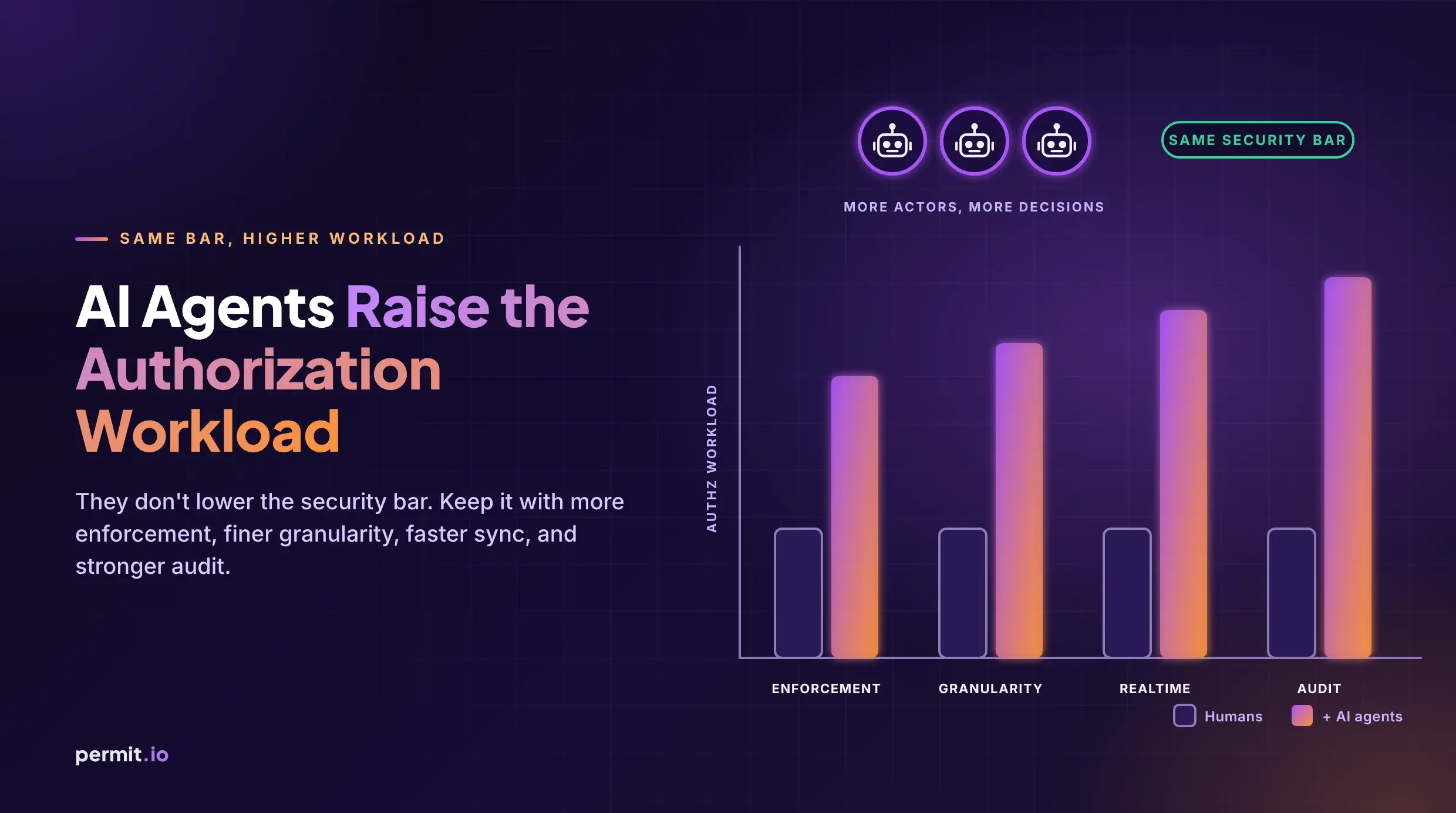
Agents raise the workload against the same control plane: more runtime enforcement at tools and APIs; finer granularity than "agent can use CRM"; realtime revoke of delegation and consent; and audit trails that preserve human-to-agent-to-tool chains. That is the point of the companion pillar: AI Agents Don't Lower the Security Bar, They Raise the Authorization Workload.
Related reading: AI agent audit trails, Why Was This Allowed?, and PEP, PDP, and Decision Logs.
Capture the audit envelope at decision time: human, agent, tool, resource, policy decision, HITL or consent state, timestamps, and correlation IDs. Store or export it through your existing audit pipeline.
This does not, by itself, guarantee SOC 2 or any regulatory outcome. Compliance depends on your full control environment and evidence process. But this is the evidence shape reviewers actually need when agents act on behalf of humans. If your platform cannot answer "who authorized this, under what policy, against which resource?" you do not yet have an audit trail. You have a trace.

Co-Founder / CEO at Permit.io