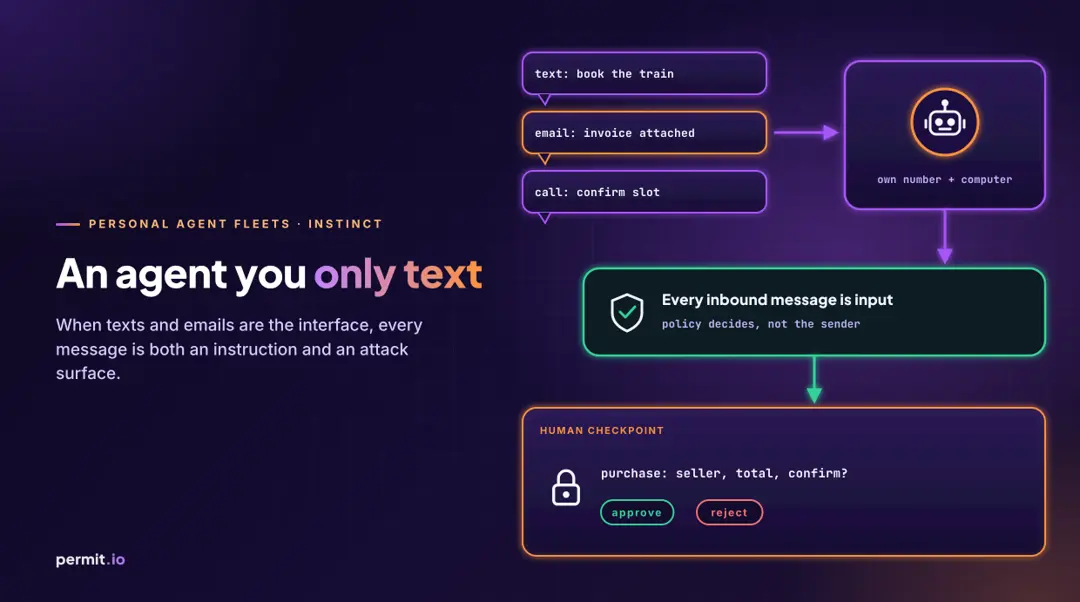
TL;DR: Instinct is a personal agent with no app: you text it, call it, or email it, and it uses its own phone number and computer to get things done in the services you connect. It asks you to confirm purchases, and you can disconnect any service. Because messages are the whole interface, every inbound text or email is both an instruction channel and an injection channel. And with a "trusted person network," your agent now talks to other people's agents. Treat it as one member of a fleet: its own identity bound to you, deny by default at the tools it reaches, a human at risky steps, and one log. Those are the controls in Software Factory Security.
What is Instinct, and what can it touch?
Instinct describes itself as "a personal assistant that understands what you're working on and what's important to you," with no new interface: "You can text or call it. It can use a phone and computer in the same way that you do." Its examples are everyday errands: ordering groceries, booking a train, sending flowers.
The Verge's hands-on review fills in the details. Instinct launched in August, invite-only. Conversations happen over iMessage, WhatsApp, or email. When it needs to log in to a site, it sends you a link to enter details in a "secure vault," and it connects to services such as Google Workspace, Slack, and Notion. In testing it emailed a doctor's office, started a return, and flagged a calendar conflict nobody asked about.
TechCrunch reported that Instinct uses its own phone number and computer for tasks, added a "concierge" that makes phone calls, and launched a "trusted person network" that lets one person's Instinct agent coordinate plans with friends' agents.
What do Instinct's terms say about acting for you?
Instinct's terms of service are worth reading for anyone evaluating a personal agent, because they describe the delegation plainly. Instinct may, on your behalf, access and interact with services you connect, and also with third-party platforms you have not separately connected.
Two controls in the terms are good practice:
- Before any purchase, Instinct asks you to confirm the goods, the seller, and the total price, and completes the purchase only on your explicit confirmation.
- You can disconnect a connected service at any time.
Some users have pushed back on how much personal information an agent like this needs; TechCrunch noted that the initial privacy policy drew criticism and has since been updated. Built In also reported user accounts of the agent taking actions without permission and falling for phishing. Those are user reports, not confirmed findings, but they describe exactly the failure modes any message-driven agent has to plan for.
Why is a text-first agent harder to secure?
With most agents, instructions arrive in one channel (your chat) and data arrives in others (email, web pages). Instinct's strength is that it lives in the channels you already use. The cost is that the line between "a message from you" and "a message to you" gets thin.
A forwarded email, a reply from a vendor, a text from an unknown number, a calendar invite: all of it is text the agent reads, and any of it can contain instructions. The model may be good at telling them apart. Whether the resulting action is allowed should not rest on that judgment alone.
The trusted person network adds a second layer. When your agent coordinates with a friend's agent, it is taking input from another agent acting for another person. That is the multi-agent problem in miniature.
What changes when Instinct is one agent among several?
Few people who use a text-based errand agent use only that. Add a work assistant with your Google Workspace, a coding agent with your GitHub token, and maybe a second personal agent, and you have a fleet, each member acting as you.
| Fleet risk |
How it shows up |
What fixes it |
| Standing access |
Each agent keeps its connected services indefinitely |
Deny by default, grants that expire |
| Delegated identity |
Every agent looks like you downstream |
An identity per agent, bound to you |
| Intent drift |
"Find swim lessons" turns into signing up and paying |
Declared intent checked on each call |
| Prompt injection |
A hostile email or text becomes an instruction |
Policy outside the model |
| Audit |
Each agent keeps its own history, or none you can query |
One decision log |
Intent drift is the subtle one. The Verge describes Instinct proactively offering information nobody asked for, which is part of what makes it useful. A policy layer should still know the difference between "research this" and "book and pay for this." We cover how to detect that gap in agentic intent and AI agent drift.
How does Software Factory Security apply?
Software Factory Security was written for fleets of AI coding agents. Its five controls are about agents acting for people, which is what Instinct does. As shared in our docs: give every agent its own identity delegated from a human, deny by default, check every call against policy outside the model, stop risky steps for a person, and keep one decision log.
Instinct's purchase confirmation is a good example of the fourth control. The point of putting it in a policy layer as well is that it then applies to every agent, not just the one that happened to build it.
Where your agents reach tools over MCP, Permit MCP Gateway signs in the person behind each agent, collects their consent, checks every tool call against policy, enforces a trust ceiling per tool, and logs each decision. For your own APIs, an HTTP egress proxy and PDP decide whether a delegated token may reach an endpoint, and the Permit PDP enforces the same policy inside your apps and data.
As shared in our docs, each agent identity binds the human who delegated the work, the client the agent runs as, the workflow, and its declared intent, so revoking the human cuts off every agent acting for them on its next call. The deny-by-default half of that is what we mean by zero standing privileges.
The Software Factory Security blueprint explains the full design.
A checklist for running Instinct in a fleet
- Connect only the services an errand actually needs, and disconnect them when the project is done.
- Use the secure vault link for logins instead of sending credentials in a text.
- Keep purchase confirmation in the loop, and read the seller and total each time.
- Be careful about forwarding email from unknown senders to the agent.
- Think about what you share with friends' agents through the trusted person network.
- Where agents reach shared work tools or your own APIs, put a per-agent policy check and a human approval for sending, paying, and deleting.
- Keep one log across agents so you can tell which one acted.
Where to start
List every agent that can send email or spend money as you, and put the highest-risk action behind one policy and one approval. The Software Factory Security page shows how each control works.