TL;DR: OpenClaw is an open-source personal agent that runs on your own machine and can browse, fill forms, read and write files, run shell commands, and message people for you. Its security page says it assumes "one trusted operator running multiple agents per gateway," and it treats prompt injection on its own, and plugins the operator installed, as outside its vulnerability scope. That is a fair model, and it puts the boundary between your agents in your config. Add policy outside the agents and their skills: an identity per agent, deny by default, a check on every call, a human at risky steps, and one decision log. Software Factory Security applies those controls to fleets of agents.
What is OpenClaw, and what can it touch?
OpenClaw is an open-source assistant that "organizes your inbox, sends emails, manages your calendar, checks you in for flights," all from the chat apps you already use: WhatsApp, Telegram, Discord, Slack, Signal, iMessage, and more. It runs on Mac, Windows, or Linux, keeps persistent memory, and supports community skills and plugins (it "can even write its own"). It is MIT licensed and stewarded by the OpenClaw Foundation, a US 501(c)(3).
The site is direct about reach: "Full System Access: Browses the web, fills forms, reads and writes files, runs shell commands. Full access or sandboxed, your choice."
The GitHub README explains the shape: "One Gateway runs it as a personal claw on a laptop or as a shared multiplayer claw." The Gateway is the local control plane for sessions, tools, events, and channels.
What security controls does OpenClaw ship?
OpenClaw's docs give practical advice, and they are honest about limits.
- The README says to "treat inbound messages as untrusted input," and DM channels pair unknown senders by default.
- The personal assistant setup guide says a connected agent "can run commands, work with files in its workspace, and message people on your behalf," and recommends an
allowFrom list, a dedicated phone number, and reviewing proactive automation jobs. It warns that linking your personal WhatsApp makes every message to you agent input.
- Sandboxing is off by default. When on, tool execution moves into a sandbox while the Gateway stays on the host. The docs call it "not a perfect security boundary, but it materially limits filesystem and process access when the model does something dumb."
- The security page lists ongoing work: scanning every ClawHub skill before listing, blocking installs of skills marked malicious, exec approvals, and an egress proxy you control.
OpenClaw has also had real incidents. CVE-2026-25253 let a malicious page exfiltrate the gateway token through an unvalidated gatewayUrl parameter, enabling one-click compromise; it was fixed in 2026.1.29. Immersive Labs investigated malicious skills published to ClawHub, which is the supply chain risk any plugin ecosystem carries.
What does "one trusted operator, many agents" mean for you?
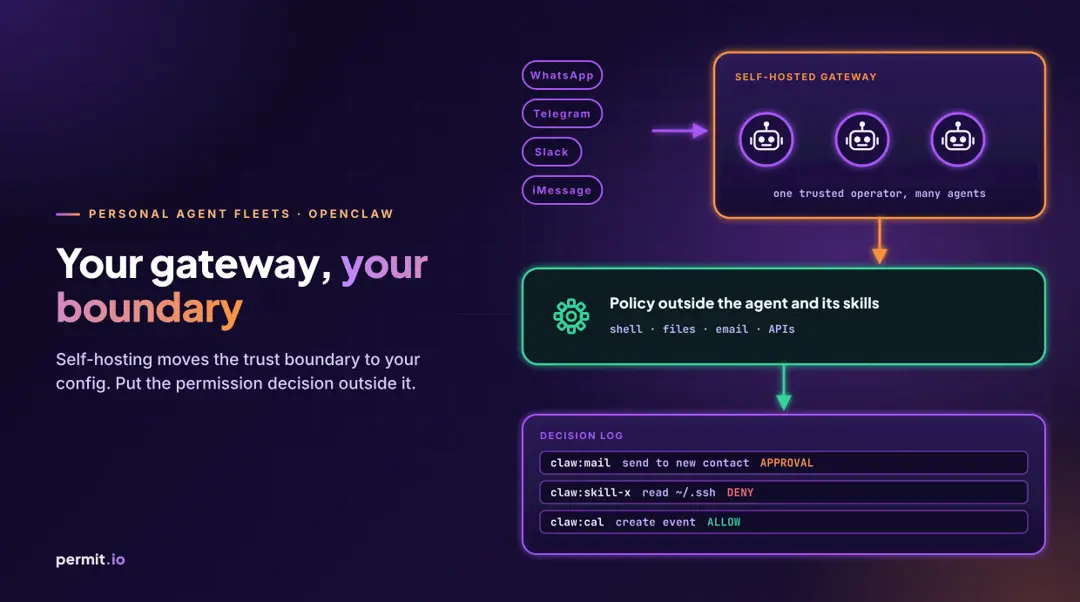
This line from the security page deserves attention: OpenClaw assumes "one trusted operator running multiple agents per gateway, not a shared multi-tenant service." Under that model, the following are not vulnerabilities by themselves:
- "Prompt injection without a policy, auth, approval, sandbox, or tool-boundary bypass."
- "Malicious behavior in a plugin installed or enabled by a trusted operator."
That is a reasonable scope for an open-source project. It also tells you where responsibility lands. If an agent is talked into misusing access it legitimately has, or a skill you installed does something you did not expect, OpenClaw considers that your policy decision. A fleet on one gateway is a fleet, and the separation between its agents is whatever your configuration says.
| Fleet risk |
How it shows up on one gateway |
What fixes it |
| Standing access |
Tools run on the host unless sandboxed |
Deny by default per agent and workflow |
| Delegated identity |
Downstream systems see your accounts |
An identity per agent, bound to you |
| Intent drift |
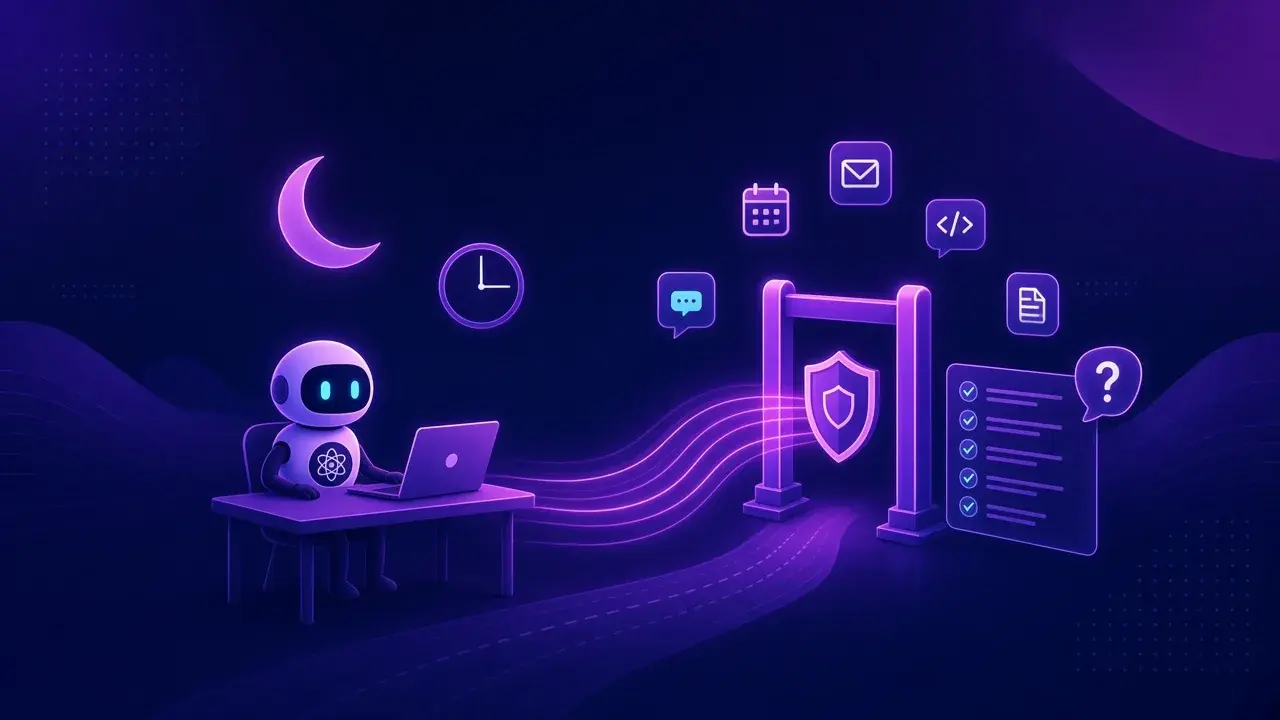
Proactive automations run while you sleep |
Declared intent checked on each call |
| Prompt injection |
Messages, web pages, and skill output steer the agent |
Policy outside the agent and its skills |
| Audit |
Each gateway and each vendor keeps its own records |
One decision log |
Why do you need policy outside the agent and its skills?
A skill runs with the agent's authority, and the agent runs with yours. Config allowlists and sandboxes are useful, and you should use them, but they live next to the thing they constrain. If the agent can edit its own workspace or write a new skill, it is close to its own rules.
Software Factory Security makes the same argument for coding agents. As shared in our docs, "Guardrails in a prompt are suggestions. Policy outside the model is a guarantee." The controls are: give every agent its own identity delegated from a human, deny by default, check every call against policy outside the model, stop risky steps for a person, and keep one decision log.
For a self-hosted fleet, that means putting the decision at the systems the agents reach, not inside the gateway:
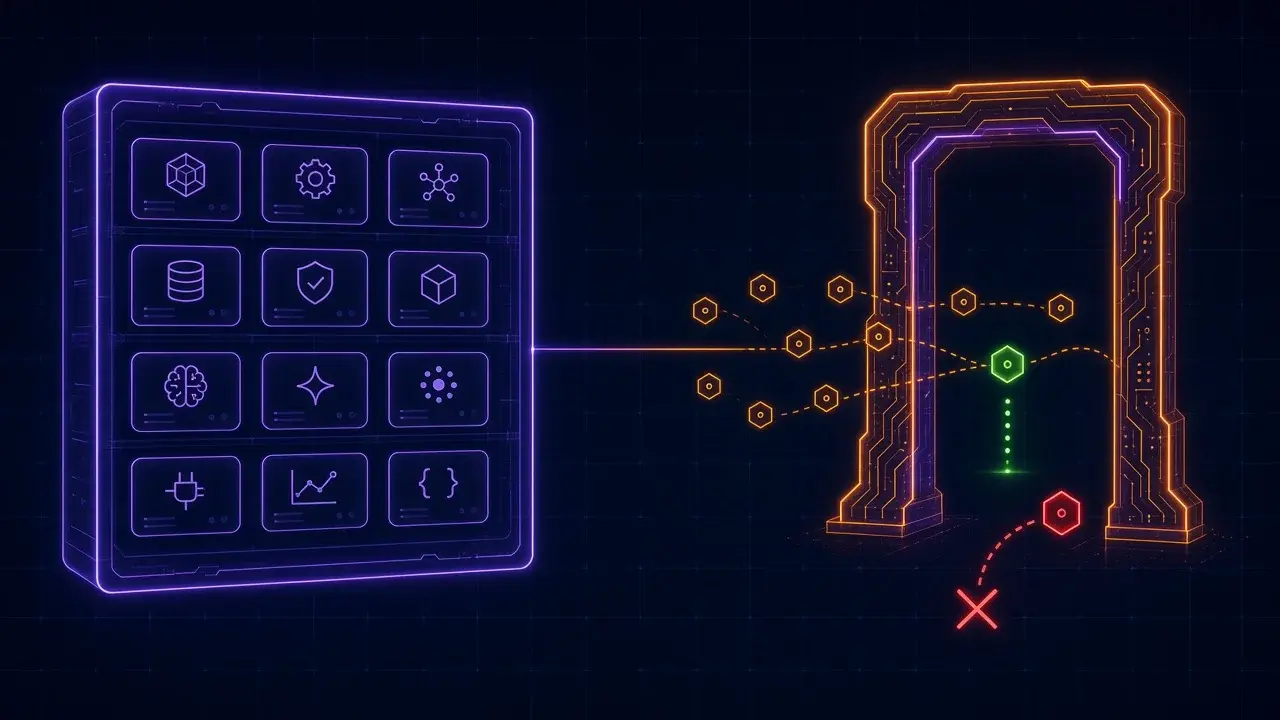
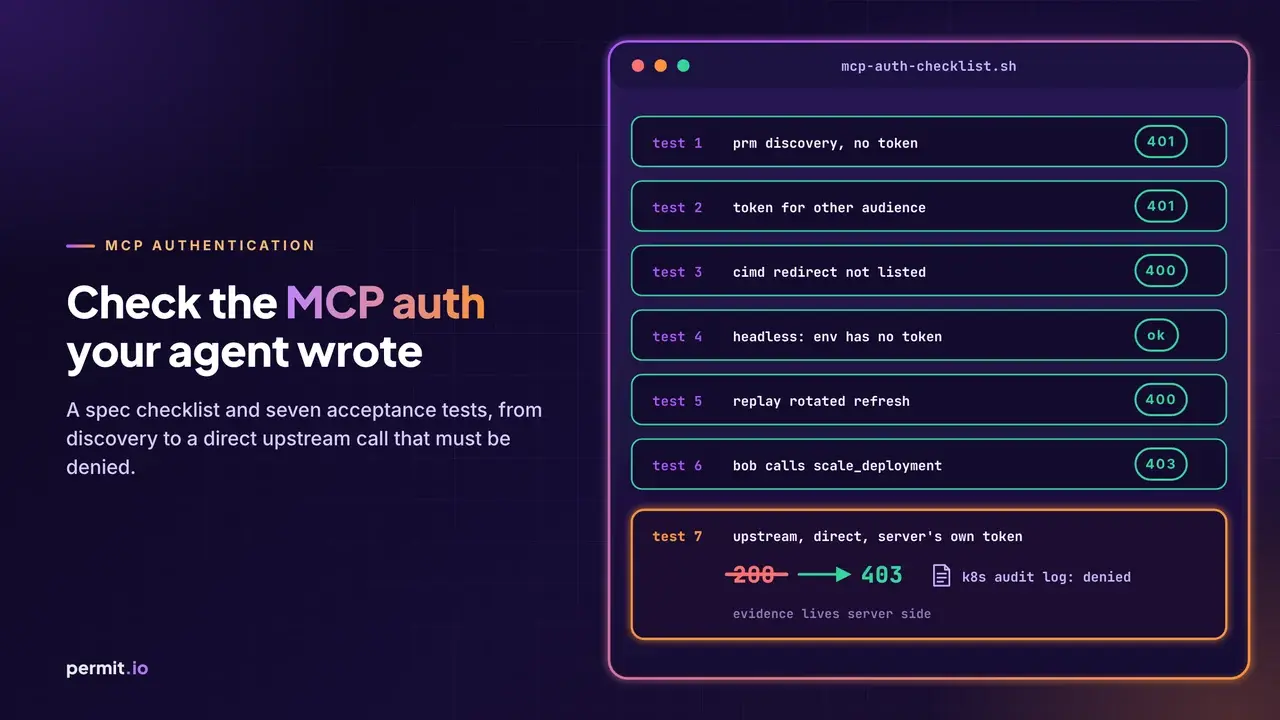
- OpenClaw can connect to MCP servers. For tools reached that way, Permit MCP Gateway sits between the client and the server. It authenticates the person behind each agent, checks each tool call against policy with a trust ceiling per tool, keeps upstream credentials vaulted so agents never hold them, and logs every decision.
- For APIs, an HTTP egress proxy and PDP decide whether a delegated token may reach an endpoint. This complements OpenClaw's own egress proxy, which controls destinations; the PDP decides what a given agent may do there.
- Inside your own apps and data, the Permit PDP checks the agent as its own subject.
Zero standing privileges is the principle behind deny by default: no agent holds access it is not using for the current task. And when something goes wrong, the agent's account of what it did is not evidence. We explain why in you can't audit an AI agent by asking it. The full architecture is in the Software Factory Security blueprint.
A checklist for running OpenClaw as a fleet
- Set
allowFrom on every channel and use a dedicated number, as the setup guide recommends.
- Turn sandboxing on for agents that do not need host access.
- Pin and review skills; prefer ones you have read. Keep OpenClaw updated and rotate gateway tokens after security fixes.
- Give each agent a narrow workspace and tool policy, and review proactive automations before enabling them.
- Put a per-agent policy check in front of the tools and APIs the agents share, with a human approval for sending, deleting, and publishing.
- Send authorization decisions for every agent to one log you can query.
Where to start
Pick the agent on your gateway with host access and an inbox, and put its outbound tool calls behind a policy check and a log first. The Software Factory Security page covers the five controls.