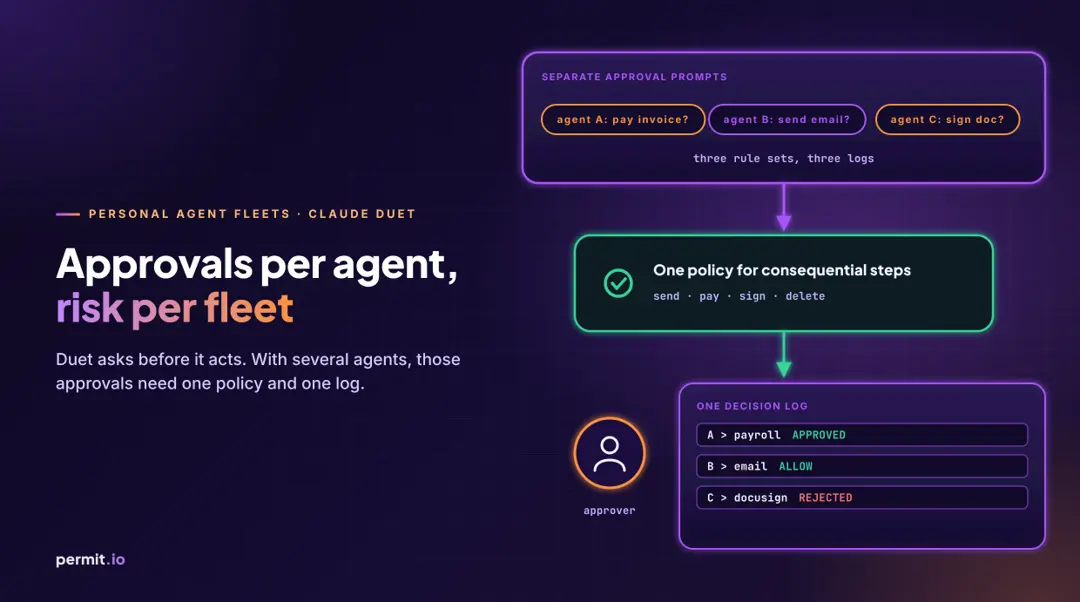
TL;DR: Claude Duet is Anthropic's proactive agent, in research preview since October 23, 2026. It checks your connected apps every few hours, works in a virtual machine with its own browser, never directly sees your passwords or sign-in tokens, and shows you exactly what it is about to do before it sends a message, makes a payment, signs a document, or deletes anything. Those are strong defaults for one agent. In a fleet, though, every agent has its own approval prompts and rules, and no single log covers them. Decide the consequential steps in one policy outside the agents, and log every decision in one place. See how in Software Factory Security.
What is Claude Duet, and what can it touch?
Anthropic introduced Claude Duet as "a new app where Claude works as a proactive agent." It is available by waitlist to US Pro, Max, and Ultra subscribers, as a standalone app on iOS and Android and on claude.ai.
Each morning it sends a short brief on the most important items across your connected apps. During the day it checks those accounts every few hours and messages you when something needs attention. You can hand it tasks from scheduling meetings to building dashboards or forecasts, and it works on them in a virtual machine with its own browser, so your laptop does not need to be on.
The reach comes from connectors. Duet carries over memory, skills, and connected apps from your Claude account, and Anthropic says it can use over 6,000 connectors and plugins in the Claude Marketplace. The examples are business systems: Gmail and Slack, QuickBooks and Stripe invoices, Gusto payroll, LinkedIn job posts, Docusign, HubSpot, Canva, and Shopify. It can also buy things through Stripe Link with a virtual card.
What safeguards does Anthropic ship with Duet?
Anthropic lists several, and they are specific:
- Credential handling follows the design used for Claude Managed Agents, "so it never directly sees your passwords or sign-in tokens."
- Actions are approved by Anthropic's auto mode classifier.
- Prompt injection defenses come from Anthropic's browser-use research.
- Red teams and an outside firm penetration tested Duet, and it is covered by Anthropic's public bug bounty.
- A dedicated classifier rejects requests to share the strictest tier of information, such as card numbers and government IDs. Health or personal finance details go out only when you have explicitly told Duet to send them.
The central control is the approval step: "before it sends a message, makes a payment, signs a document, or deletes anything, it shows you exactly what it's about to do and waits for your approval." Some actions are off-limits even with approval, like trading securities or moving money between accounts. You can disconnect any app.
Anthropic is also upfront that the preview "still might misread a thread or miscalibrate what's urgent."
Why are per-agent approvals not enough for a fleet?
Approval before consequential actions is exactly what we recommend. The issue is where the approval lives.
Duet's approvals live in Duet. If you also run a coding agent with repo access, an always-on assistant from another vendor, and a self-hosted agent on a home server, each has its own approval prompts, its own idea of what counts as consequential, and its own history. Three things follow.
You approve the same kind of action in several places under several rule sets. A payroll run might need your approval in one agent and go through automatically in another that holds the same Gusto connection.
Approvals get tiring. When prompts arrive from four agents, people start approving by habit, which removes most of the value.
Nobody holds the whole record. If an invoice reminder went to the wrong customer, you need to know which agent sent it, for whom, under what approval. Each agent can only tell you about itself.
| Fleet risk |
How it shows up |
What fixes it |
| Standing access |
Connectors carried over from your account stay connected |
Deny by default, grants per workflow |
| Delegated identity |
Gmail, Stripe, and Gusto see you, not the agent |
An identity per agent, bound to the delegating human |
| Intent drift |
A morning brief turns into drafting and sending replies |
Declared intent checked on each call |
| Prompt injection |
A hostile email arrives in a monitored inbox |
Policy outside the model |
| Audit |
Approvals and actions split across agents |
One decision log |
How does Software Factory Security apply to Duet and the rest of the fleet?
Software Factory Security was written for fleets of AI coding agents. Its fourth control, humans at risky checkpoints, is what Duet does for its own actions. As shared in our docs, the full set is: give every agent its own identity delegated from a human, deny by default, check every call against policy outside the model, stop risky steps for a person, and keep one decision log.
Applied across a fleet:
- Each agent gets its own identity that binds the human who delegated the work, the client the agent runs as, the workflow, and its declared intent. That record is what makes delegation traceable; we cover it in human-agent delegation and the audit trail.
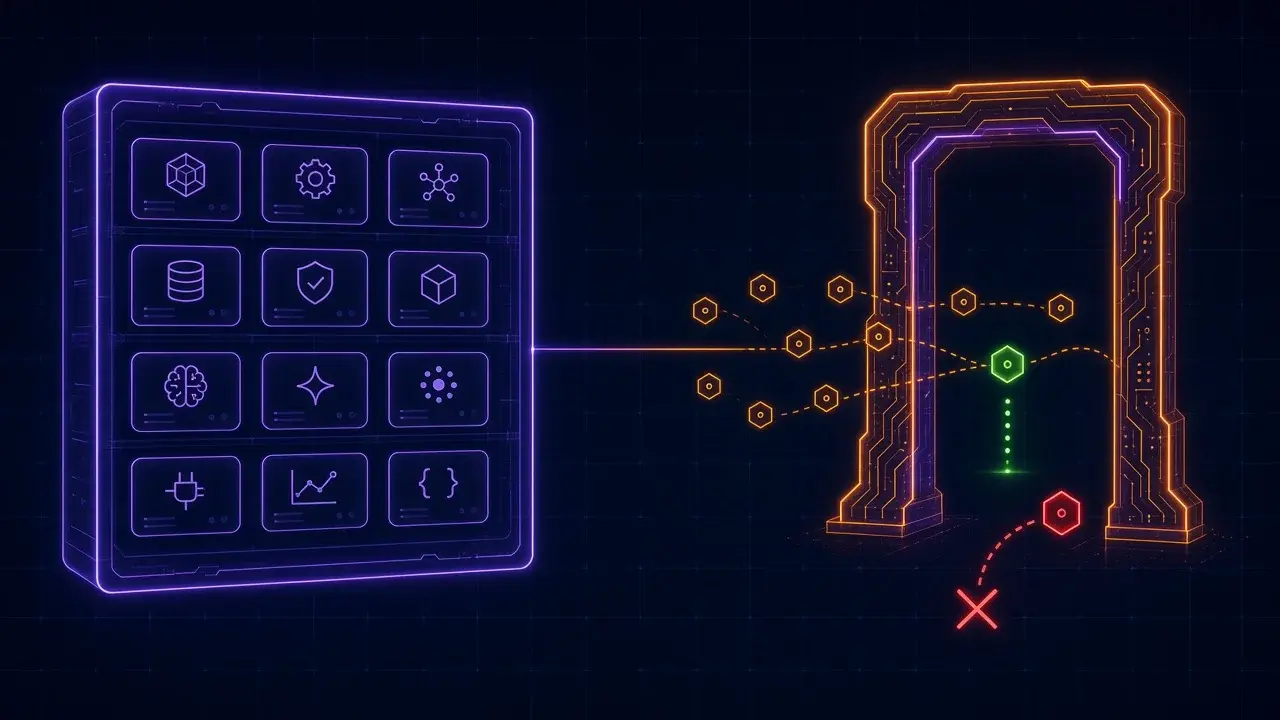
- Consequential actions are defined once, in policy, and every agent's calls are checked against it. For agents that reach tools over MCP, Permit MCP Gateway checks each tool call, applies a trust ceiling per tool, and can hold a call for approval. As shared on our SFS page, approvals can be routed to the dashboard or Slack and reject on timeout; the human-in-the-loop docs cover the setup.
- For APIs, an HTTP egress proxy and PDP decide whether a delegated token may reach an endpoint. In your own apps and data, the Permit PDP enforces the same policy.
- Every allow, deny, and approval lands in one decision log with the agent, the human, the tool, the time, and the reason.
Intent drift deserves its own note for proactive agents. A brief-and-monitor agent that starts drafting and sending replies is doing something different from what you set up. Checking declared intent on each call catches that shift; we explain how in agentic intent and AI agent drift.
The architecture is in the Software Factory Security blueprint.
A checklist for running Claude Duet in a fleet
- Review which connectors carried over from your Claude account, and disconnect the ones Duet does not need.
- Read each approval card in full, especially recipients and amounts.
- Tell Duet what you want to hear about, so its messages stay useful.
- Write down which actions count as consequential for you, once, and apply that list to every agent.
- Put a per-agent policy check in front of the shared business systems (email, payments, payroll, signatures).
- Keep one decision log across agents and send it somewhere you can search.
Where to start
Pick the business system that more than one of your agents can write to, often email or invoicing, and put one policy and one approval flow in front of it. The Software Factory Security page explains each control.